
Most restaurants, until very recently, could be categorized under either full-service or limited service. Full-service, as the name suggests, is a typical table-service restaurant. Limited service, on the other hand, can be of many types – quick-service, fast casual, cafes, etc. Each one of these has a very different business model, but in this article, for starters, we’re only going to cover the two big players, i.e., fast casual vs. QSR.
What You’ll Learn
- Key differences between fast casual and QSRs.
- Pros and cons of both models and which one you should choose if you’re planning to start a limited service restaurant.
What are Fast Food/Quick Service Restaurants?
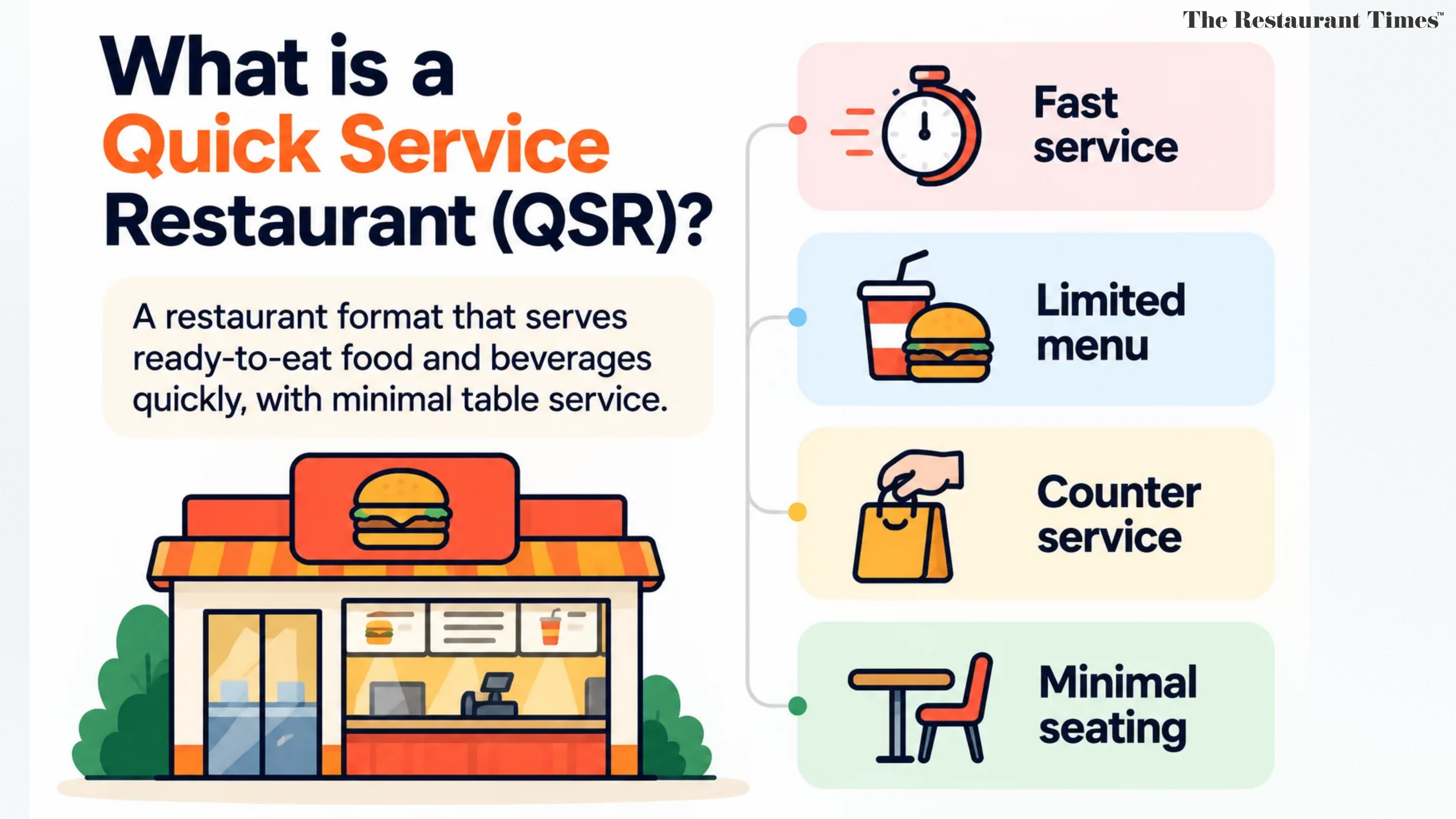
Quick service restaurants (QSRs) are restaurants that focus on throughput, convenience, and standardized food preparation. At such restaurants, customers typically order at a counter, kiosk, drive-thru, or via a mobile app. They receive their food very quickly, and they can choose to either take it away or maybe even eat in a casual setting.
Key characteristics of QSRs are:
- Fast service and short wait times
- Limited table service (or mostly none at all)
- Standardized menus across every outlet of that brand
- High emphasis on overall operational efficiency
- Affordable prices
- Strong reliance on delivery or takeout
Some very famous global QSR brands are McDonald’s, KFC, Burger King, Subway, Domino’s, Pizza Hut, Taco Bell, etc.
Now, why are QSRs becoming so popular these days? It must be because of how strongly these models align with modern consumer behavior. Like, people have busy lifestyles; they want convenience at every step, plus food delivery apps are a go-to for most of them – QSRs fit into their demand really well.
What are Fast Casual Restaurants and How Do They Work?
If QSRs compete on speed and consistency, fast casual restaurants are definitely big on quality, experience, and customization. These restaurants are somewhere in the middle of fast food restaurants and full-service restaurants.
They offer higher-quality food, fresher ingredients, more customization, and a more upscale dining experience, along with quick ordering and service as seen in limited-service restaurants. They operate much faster than casual dining but slower than QSRs + they do not often offer drive-thru services.
Some popular fast casual brands are Chipotle, Sweetgreen, Panera Bread, Cava, Shake Shack, etc.
Fast Casual vs. QSR: Difference at a Glance
| Comparison | Fast Food Restaurants | Fast Casual Restaurants |
|---|---|---|
| Target Audience | Budget-conscious, convenience-focused consumers | Quality-conscious consumers seeking convenience |
| Service Model | Counter service, drive-thru, kiosks, delivery | Counter ordering, self-service pickup, limited staff interaction |
| Speed of Service | Usually 2-5 minutes | Usually 5-15 minutes |
| Food Preparation | Highly standardized and often partially pre-prepared | More made-to-order preparation. Offers broader menus with more variety. |
| Ingredient Quality | Consistent, cost-efficient ingredients | Fresh, premium, and often locally sourced ingredients |
| Price Point | $5 to $10 | Mid-tier – about $12 average check |
| Ambience | Functional and efficient – built for high turnover | Comfortable, modern, and experiential |
| Average Ticket Size | Lower | Higher |
| Profit Driver | High transaction volume | Higher average order value (AOV) |
Is Fast Casual Dining Really More Upscale?
Well, perception does say yes. Fast casual dining is perceived as more upscale than fast food, plus it’s backed by a pleasant, modern design.
If you go by order, it’s something like:
Fast food < fast casual dining < casual dining < full-service restaurant with table service < fine dining restaurants
Fine dining restaurants are always top-notch when it comes to that upscale feel. Fast casual dining is definitely bigger on experience (without fat bills) than QSR in comparison.
Does the Dining Experience Matter More Than Speed?
Well, it totally depends on what customers need. If you want to grab a quick burger on the go, you might not value ambiance as much as speed at that moment. Similarly, if you’re out with your friends and want to quickly catch up with them, it would be better to go to a fast-casual restaurant – they offer a much better dining experience at a very affordable rate.
Since fast food restaurants prioritize function over form, QSR interiors are designed for quick clearing and minimal lingering. Quick service restaurants have bare-bones interiors, and layouts prioritize high-volume customer turnover.
Fast casual restaurants, on the other hand, have comfortable seating, inviting decor, calmer ambiance, and a relaxed atmosphere that encourages customers to linger longer; basically, a “better experience” is what customers pay for.
In terms of pricing, quick-service restaurants are super budget-friendly, and menu items here cost only between $5 and $10. Prices are low and mostly value-focused. Fast casual restaurants, on the other hand, have mid-tier pricing, especially because it accounts for premium ingredients and customization.
INDUSTRY INSIGHT
| Quick-service restaurants have a structural advantage in store-level profitability, with typical 4-wall EBITDA margins of 18% to 22%, compared with 15% to 20% for fast-casual restaurants. This difference is due to their focus on throughput and labor efficiency. QSRs rely on streamlined menus, faster service, and high transaction volumes, while fast-casual concepts command higher average checks of $13 to $22 but carry higher food and labor costs. Now, which format you should pick is a trade-off between maximizing volume vs. generating more revenue per transaction. |
How Do You Decide Which Restaurant Format Is Right For You?
You should choose a QSR if you want to scale quickly, your budget is limited, you’re targeting mass-market customers, you want simple operations, and you plan to franchise in the future.
QSRs come with:
| Pros | Cons |
|---|---|
|
|
As for fast casual, you should choose this if you want a stronger brand positioning, you focus a lot on food quality and experience, you have unique recipes or a chef-driven concept, and you’re targeting middle- and upper-income customers.
Pros and cons of the fast casual restaurant model are:
| Pros | Cons |
|---|---|
|
|
What Does the Future Hold?
The future is most probably a “hybrid.” For example, in November 2024, Chipotle opened its 1,000th drive-thru “Chipotlane,” nearly 30% of its 3,600-plus restaurants. Chipotle is a fast-casual restaurant, and it had no business getting into drive-thru as well…but it did and is thriving. Similarly, many QSRs today offer casual table service as well. Moreover, these days, convenience stores too are becoming meal destinations.
So, who wins? Winners “will be those that resist being pulled too far to one side or the other.”
KEY TAKEAWAYS
| – In the restaurant industry, fast casual restaurants and fast food restaurants are both limited service restaurants, but their service style, price, and operational priorities differ. Quick service restaurants emphasize speed, consistency, affordable prices, and high volume, while fast casual restaurants focus more on food quality, fresh preparation, and customization. – Fast food appeals to consumers who want a convenient meal at an accessible price. Fast food chains such as Taco Bell and Subway rely on standardized processes, efficient counter service, and clear menu board communication. A pizza restaurant can follow a similar model when speed and convenience drive its operations. – Fast casual restaurants typically offer higher quality food, made-to-order items, and greater menu flexibility. However, higher quality ingredients and a more appealing atmosphere can increase operating costs, so a higher price does not automatically guarantee better quality or higher profits. – Both fast food and fast casual concepts need consistent execution, great food, and a service style that aligns with customer expectations. Fast casual restaurants can emphasize speed, while fast food establishments can improve their dining experience through fresher options and more welcoming spaces. – For operators, fast food offers opportunities to scale through repeatable systems and high transaction volumes. Fast casual restaurants can build stronger brand differentiation through product quality, customization, and a distinctive menu. The right business depends on location, labor costs, menu complexity, and what customers are willing to pay. – Fine dining and full-service restaurants generally involve more personalized hospitality than quick-service formats. Fine dining emphasizes presentation and a deliberate pace, while fast casual restaurants balance convenience with a more relaxed experience. Each model serves a different customer need. – The food industry is increasingly blurring these boundaries. Restaurant chains are combining digital ordering, drive-thru access, premium menu options, and improved seating. The opportunity lies in adapting to changing consumer preferences without losing the business model’s core strengths. |
Frequently Asked Questions
1. Is fast casual considered QSR?
Not QSR really, but fast casual restaurants do fall within the broader limited-service segment. The difference between a fast casual restaurant and a quick service restaurant can be told by looking at the menu, pricing, and preparation methods both employ to create those items. Both formats do offer counter ordering and digital ordering, but fast food typically prioritizes speed, standardized preparation, and affordable prices.
Fast casual restaurants go much bigger on using fresh ingredients, offer you customization options, and comparatively offer high-quality service. They also offer you more comfortable seating and a relaxed atmosphere.
Basically, both formats can deliver quick service, but the core difference is in how they balance convenience, food quality, and the overall customer experience.
2. Is Chick-fil-A QSR or fast casual?
Chick-fil-A is generally classified as a quick-service restaurant (QSR), rather than a fast casual restaurant. Its business model centers on fast food convenience, standardized operations, counter ordering, and drive-thru service.
Although Chick-fil-A is known for its hospitality and consistent food, those characteristics do not automatically place it in the fast casual category. Its emphasis on efficient service, repeatable processes, and a consistent customer experience aligns more closely with traditional QSR operations.
3. What is the difference between fast casual and casual dining?
The primary difference is the service style. Fast casual restaurants generally use counter ordering, limited table service, and relatively quick preparation. Casual dining restaurants typically provide table service, a longer sit-down meal, and more interaction with staff.
Fast casual restaurants often offer fresh preparation, customizable menu items, and a comfortable setting without the time commitment of a traditional sit-down restaurant. Casual dining establishments may offer a broader menu, appetizers, desserts, and alcoholic beverages, encouraging customers to spend more time at the table.
Fine dining is a more formal format, distinguished by personalized hospitality, elaborate presentation, and a more deliberate pace. While fine dining typically commands higher prices, casual dining and fast casual restaurants occupy different positions based on the level of service, atmosphere, and convenience they offer.