
Having Google reviews has become one of the greatest trust signals any small business can have at its disposal. In reality, more than 80% of customers will search for Google reviews before visiting the business’s location in person, and consumers do not trust businesses whose average rating is below four stars.
The best part about generating more Google reviews for a small business is the fact that there is no complicated process or any costly software involved. All it takes to improve things is just a simple question, and this guide will help you understand when and how to ask it.
What You Will Learn
- Why Google reviews affect your local search rankings and bottom line
- Effective ways to solicit reviews offline and online
- Dealing with negative reviews without breaking trust
- What you can do under Google’s rules and what you cannot
Why Google Reviews Matter for Your Business
Reviews are now considered a significant part of the Google Local Pack ranking algorithm, with 16 to 20% weightage in 2026. The reviews of your business on Google are responsible for determining your inclusion in the local search results based on the services provided by your business.

In other words, this point highlights an aspect that most companies do not consider when dealing with reviews: engaging with them on a larger scale is a question of resource allocation, not simply of tactics. The very act of being engaged with reviews in this manner is a leadership decision.
The Revenue Impact of Reviews
Businesses with a higher-than-average number of reviews across sites generate 54% more revenue, highlighting the financial impact of Google reviews. Google reviews act as social proof, influencing potential customers’ trust and decisions, which can lead to increased foot traffic and online engagement.
Reviews as a Trust Signal
“Customer reviews are the most influential form of local business content, and 90% of consumers read reviews as they search for nearby goods and services,” according to Search Engine Land. Star ratings keep rising in importance according to the 2026 local consumer review survey data, with consumers placing increasing weight on aggregate ratings. Businesses with fewer than 10 reviews struggle to compete, while crossing thresholds like 10, 50, and 100 reviews makes a business look more established and trustworthy.
Set Up Your Google Business Profile Before You Start: Get More Google Business Reviews
Before asking a single customer for a review, your Google Business Profile needs to be complete and accurate. A well-maintained Google Business Profile helps customers feel confident in choosing your business, as it shows that you are active and trustworthy.
Optimize Your Business Listing on Google Maps
A few quick things to check in your account settings:
- Your business name, address, and phone number are accurate and consistent across the web
- Your business listing includes high-quality photos of your location, products, or team
- Your hours and contact information are current and relevant
Find Your Google Review Link
Once your profile is in order, find your direct Google review link. This is the single most important tool for review collection, as it removes the friction of customers having to search for your business name on Google search and find the right listing themselves.
The Psychology Behind Why Customers Leave Reviews
Most happy customers do not come forward and write their reviews; they need to be reminded of the act. 70% of customers will write a review when they are reminded. Businesses that follow up on reviews end up with better average ratings compared to businesses that don’t do so.
There is an optimum time when the review can be requested. The optimum time is after or during the positive experience. However, to ensure that a good review is written, the reminder process should be made as seamless as possible.
How to Ask for Google Reviews: In-Person Strategies
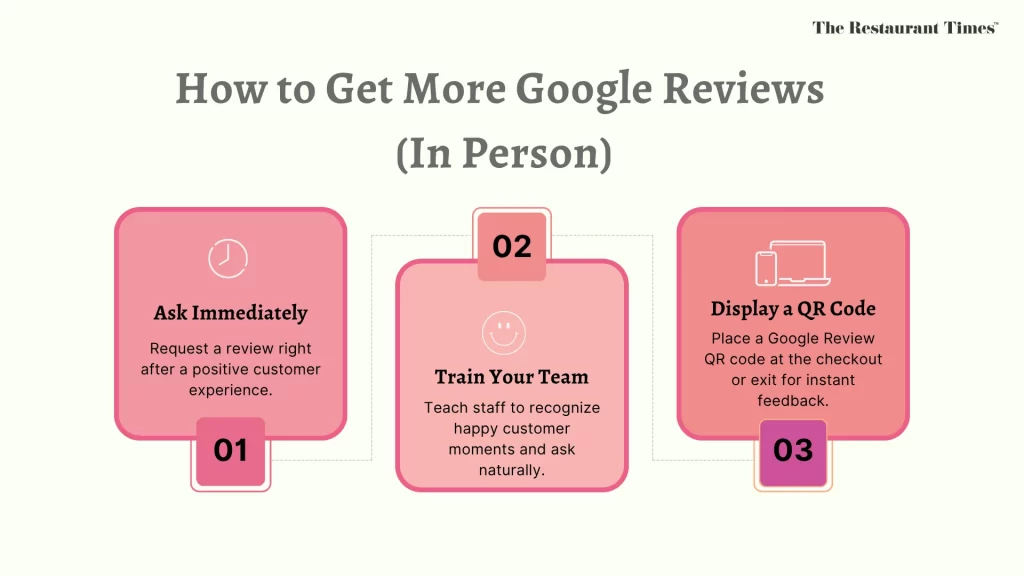
Over 80% of consumers look at Google reviews before visiting or shopping at a business, and customers don’t trust companies with a lower than a 4-star rating average. Businesses with higher ratings across sites generate 54% more revenue, highlighting the financial impact of Google reviews. Google reviews act as social proof, influencing potential customers’ trust and decisions, which can lead to increased foot traffic and online engagement. Embedding a Google reviews link in your email signature can serve as a passive reminder for customers to leave feedback, increasing the likelihood of receiving reviews over time. Here is a detailed discussion on how to ask for Google Reviews:
Ask Right After Service Completion
Regardless of whether you operate a restaurant, a salon, or a repair business, the time a customer feels content about your service is when you should act on it. A single request made immediately after a positive customer interaction works much more efficiently than a generalized invitation made after several days of service.
Train Your Team to Recognize the Moment
Employees who will be able to recognize moments where customers will feel satisfied by asking for reviews during such moments will increase the probability of getting feedback. Making review requests during normal customer interactions will help in increasing the number of feedback received from customers.
Use a QR Code at the Point of Sale
Creation of a QR code directing to the Google review page will make it easier for customers to leave feedback immediately after having a customer experience.
How to Ask for Google Reviews: Digital and Follow-Up Methods
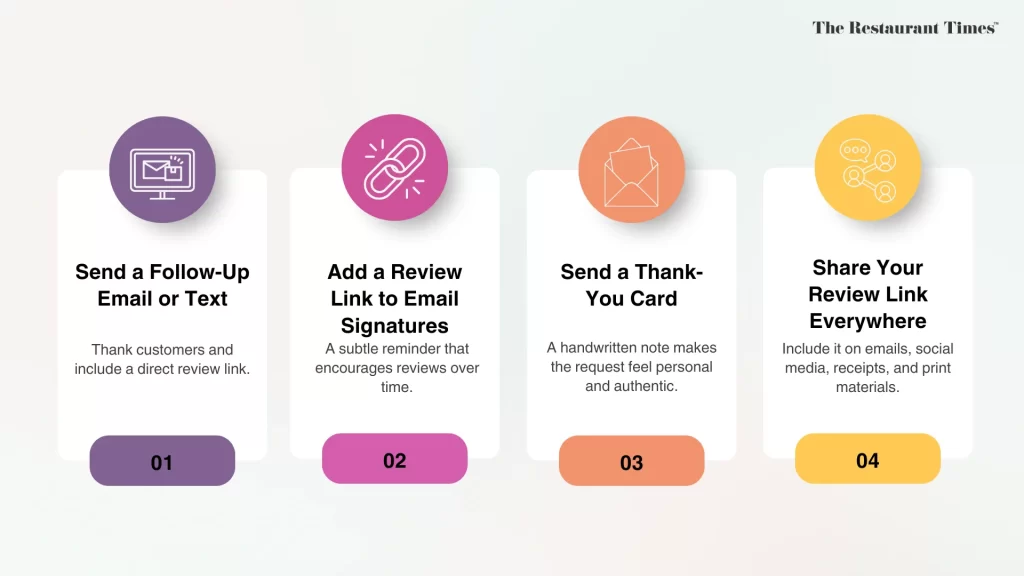
A well-maintained Google Business Profile helps customers feel confident in choosing your business, as it shows that you are active and trustworthy. Google reviews can significantly impact your visibility in search results and on Google Maps, making it essential for businesses to optimize their profiles to attract more customers. Let’s explore how you can follow up on Google reviews:
Send a Follow-Up Text or Email
Sending a follow-up email or text message after a service or purchase, thanking the customer and including a direct link to leave a review, can effectively prompt them to share their feedback. Sending personalized follow-up messages can improve review response rates.
Embed Your Review Link in Email Signatures
“Adding a link to review your business on Google in your email signature is a great way to ask for more Google reviews without actually asking!” according to WordStream. Having the Google reviews link embedded in your email signature acts as a subtle reminder to your customers to leave their reviews, thus increasing the chances of getting reviewed in the long run.
Send a Handwritten Note or Thank You Card to Enhance Customer Experience
A handwritten postcard along with a review request is an effective way to personalize your thank-you message for services provided to your customer. This feels natural and humane. This technique is especially good for a small business brand.
Use a Direct Review Link Everywhere
Creating a direct link for people to submit reviews can greatly increase the quantity of reviews that you get; this link could be sent through email, social media, or in print form. The fewer clicks there are from intention to action, the more likely you will convert.
The Copy-Paste Method for Existing Praise
Among the most underutilized resources when it comes to creating reviews is right within reach from your computer. When someone from your list of past clients sends a thank you message or some other expression of gratitude towards your service, you get your review ready for posting; you just need to ask that person to place it on Google Maps or your company page itself.
A simple email does the job well; just ask that person to take what he or she has already written and post it as a short Google review by following the provided link. This method yields a very high conversion rate, because the person has already invested both emotionally and in words.
INDUSTRY INSIGHT
| Reviews now account for 16 to 20% of the Google Local Pack ranking algorithm in 2026, a weight that has steadily increased as Google continues refining how it ranks local search results. For business owners, review volume and review velocity are no longer just reputation metrics. They are functioning as a direct local SEO lever, on par with traditional ranking signals like proximity and relevance. |
What You Can and Cannot Do: Google’s Policies
First, understand the new Google Review Policy updates in 2026, watch:
Google allows businesses to solicit reviews, but requests must be neutral and accessible to all customers, not just those who had positive experiences, to avoid being classified as selective solicitation. Google’s policy prohibits incentivizing reviews, meaning businesses cannot offer discounts, gifts, or any form of compensation in exchange for reviews, as this can lead to penalties such as review removal or account suspension. Purchasing or fabricating reviews violates Google’s policies and can result in penalties. Google’s policies state that reviews submitted from the same IP address, such as those from a business’s WiFi or in-store devices, may be flagged as conflicts of interest, which can lead to review removal or account suspension. Let’s understand the best practices in detail:
You cannot pay for Reviews
Buying reviews or creating them goes against Google’s guidelines and could lead to penalties. Google’s guidelines ban incentivized reviews because it is not allowed to offer rewards or gifts to customers in exchange for reviews, and this may bring penalties like removing reviews and suspending accounts.
You cannot Selectively Solicit Only Happy Customers
While Google does allow companies to solicit reviews, the request must be neutral and available to all customers, and not just happy customers.
You cannot Set Up Devices for On-Site Reviews
Be careful not to arrange anything that will allow your customers to post reviews, since this will activate the spam filters. The guidelines from Google say that if the reviews come from the same IP address – for example, from WiFi within the business itself- then this could be considered a conflict of interest, and the reviews can be removed.
You cannot send a Sudden Flood of Requests
If you have a sharp increase in the number of requests–for instance, if you go from having 1 review per month to 40 reviews very quickly–this may get picked up by the moderation system at Google and get you into trouble.
How to Respond to Negative Reviews
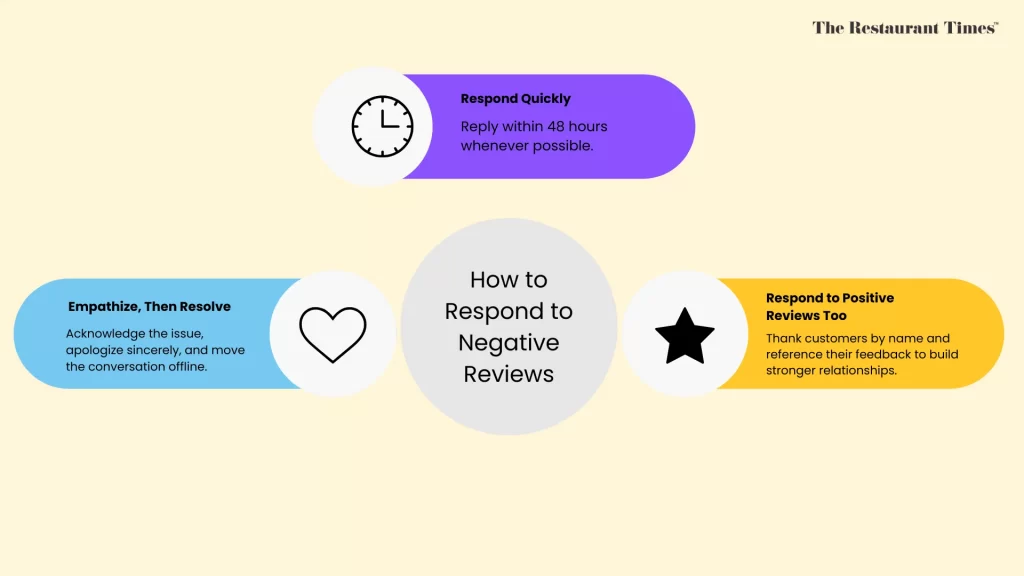
A bad review is not a death warrant for your business but an opportunity to build trust, if done right. Negative reviews need to be apologized for and acknowledged immediately, per SBA advice, to make them a positive experience.
Respond Promptly
Respond to each and every review in 48 hours to prove that you value and take customer feedback seriously.
Empathize First, Then Resolve
When responding to negative reviews, show empathy towards the reviewer, move the discussion offline, and present the next steps for solving the problem, as this strategy will work for other potential customers who might be reading the dialogue. Most of the time, negative reviews have to be answered rather than argued with.
Respond to Positive Reviews Too
When responding to positive reviews, acknowledge the reviewer by name and reference specific details they mentioned to reinforce the service provided. Responding to all reviews, both positive and negative, shows customer engagement and professionalism. Replying to customer reviews results in better ratings, according to Harvard Business Review research on review management practices.
Google itself reinforces this: “Respond to reviews that users leave about your business. When you reply to reviews, it shows that you value your customers and their feedback. High-quality, positive reviews from your customers can improve your business visibility and increase the likelihood that a shopper will visit your location.”
KEY TAKEAWAYS
| – Reviews directly influence both your local search ranking and your conversion rate — 70% of customers will leave a review if simply asked – In-person requests at peak satisfaction and QR codes convert better than passive or delayed digital asks – Google’s policies allow you to ask for reviews but prohibit incentivizing positive ratings, selective solicitation, and review gating – Responding to every review—positive and negative—within 48 hours builds customer trust and signals an active, engaged business |
Frequently Asked Questions
1. Is it legal to buy Google reviews?
No. Buying or making reviews is against Google’s policy and may lead to penalties such as deletion of the review or complete suspension of the business listing. The businesses should neither buy reviews nor incentivize reviews that go against platform policies.
2. Is review boosting illegal?
It all comes down to the way in which this is done. While the proper form of review boosting, which entails soliciting opinions from actual clients via follow-up emails, QR codes, and personal approaches, is perfectly legal and even sanctioned by Google, the moment any kind of incentive is tied to favorable opinions, it becomes illegal.
3. How to get 4.8 on Google reviews?
A 4.8 rating is a result of consistent gathering of reviews paired with excellent service. Question each and every customer, but not only those who are definitely satisfied with their stay, because that is what Google requires for their policy, and ensures an honest rating. Answer all the reviews and take advantage of the highest point of customer experience for a personal question.
4. What are legitimate alternatives to buying reviews?
Among the best ways to collect reviews are directly asking a customer in person immediately after a positive experience, sending a follow-up text or email with a direct review link, using QR codes on receipts, incorporating the review link in email signature lines, and copying and pasting unsolicited reviews.
5. How do you respond to negative reviews to protect your rating?
Respond within two days with empathy rather than defensiveness. Admit their frustrations and keep the resolution away from the public eye. Provide a way forward by offering something like a refund or scheduling a discussion. Avoid debating in public, as your response can have an even stronger impact on your company’s reputation than any bad review ever could.