
It’s easy to think that ‘making big’ on social media is all about who can spend the most on ads, but that’s really just the tip of the whole story. No matter what social media strategy you employ, whether you succeed or not will boil down to how good you are at building connections and getting people to actually care about what you’re doing and plan to do in the long run.
The hardest part is that growing on Instagram is not that easy, especially when your time and budget are tight, but do you really have any other choice?
Over 85% of diners discover restaurants through social media, and approx 70% of them check your Instagram profile before deciding to visit. In fact, businesses with an active online presence have repeatedly reported 25% more local bookings. And maybe that’s why so many experts advocate for investing in restaurant Instagram marketing. The platform is super affordable, and you can make as many pages as you want, which comes in really handy when you are running more than one brand/outlet.
So, how do you get started? This article will walk you through three key things:
What You’ll Learn
- Why Instagram is an indispensable tool for the overall food industry in 2026
- 15 actionable strategies that will help you grow your business online, and
- Common mistakes you should avoid when posting on Instagram.
Let’s get onto the first!
Why Should Restaurants Be on Instagram in 2026? Does It Actually Help?
Short answer: yes, it does. It does help a lot. Long answer: let’s look at the numbers –
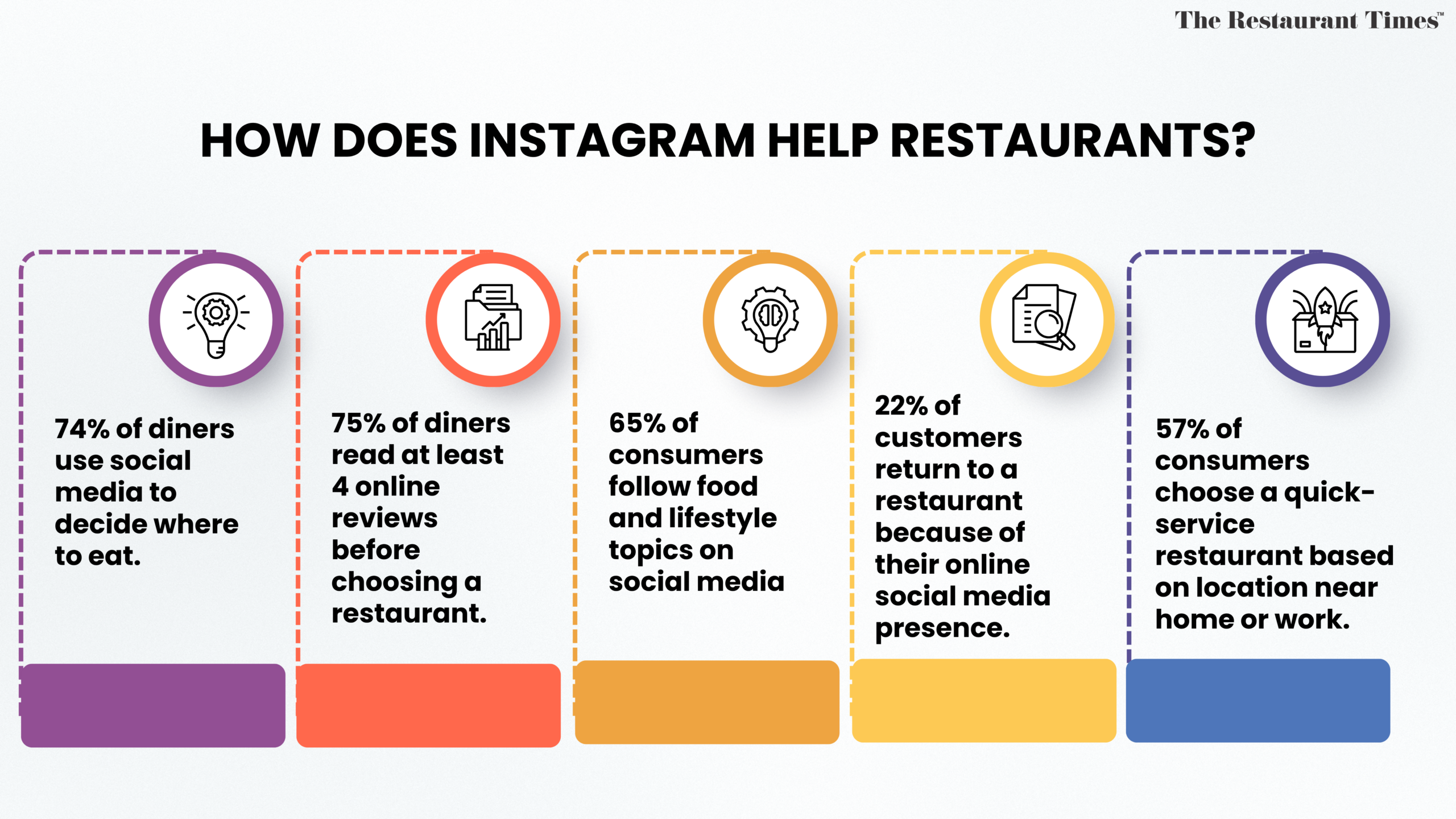
In the United States specifically,
- 74% of diners use social media to decide where to eat.
- 57% of diners book restaurant reservations directly through social media platforms.
- 84% of consumers search for local businesses online daily, and 75% read at least 4 online reviews before choosing a restaurant.
65% of consumers follow food and lifestyle topics on social media, making it the largest community among those surveyed, according to Deloitte Digital. And when people specifically want to find somewhere to eat, Instagram-style discovery literally takes the top spot.
From a customer loyalty perspective, 22% of restaurant customers return to establishments because of their Instagram presence. And even in the fast-casual and quick-service space, where you’d expect price and menu items to dominate the decision, 57% of consumers choose a quick-service restaurant based on location near home or work, even over better food quality or app features, according to PwC, which makes it all the more important for local businesses to use geotagging and local hashtags more prominetly (more on that below).
Now, if you zoom out a bit, the restaurant industry itself is growing very fast. It’s projected to reach $1.55 trillion in sales nationwide by the end of 2026, with real inflation-adjusted gains of 1.3%, per the National Restaurant Association. That’s a lot of appetite, and Instagram is one of the cheapest ways to capture a slice of it.
15 Instagram Marketing Strategies That Bring Customers Through the Door
#1: Set Up Your Restaurant Profile to Boost Visibility
The first step to winning on Instagram is to make sure people can find you and that their first impression of your brand is positive. For that, your profile must have a clear bio with exact details of what you serve and where you are located, a high-quality profile pic, and the right name.
A few tips:
- Switch to a business account. With this, you’ll be able to access Instagram Insights, use action buttons, and run ads.
- Your username should technically be your restaurant’s name. This improves your brand’s visibility both on Instagram and in search results.
- In your bio, briefly introduce your restaurant – where are you located? What cuisine do you serve? Are there any special offerings or promotions going on?
- Since Instagram allows you to pin only one clickable URL in your bio, you can link it to your website or a Linktree, so it’s easier for diners to access online ordering or any other CTA you want to redirect them to.
Number five and most important, make sure people can find you on Google, too.
In July 2025, Meta announced that all public professional Instagram accounts would be indexable by search engines like Google. This means Instagram content can now rank in Google search, provided it is well optimized with captions and bios that include specific keywords.
#2: Build an Actionable Content Strategy
A content strategy is a decision you make well in advance about what you’re going to say on social media, how often, and why.
If you don’t have a proper content calendar/strategy, you may end up not posting anything for a week, let’s say, or post any random “Monday quote” just for the sake of it.
If you’re a single restaurant, you should build repeatable content pillars like a reel showcasing one signature dish or a customer’s favorite dish per week, behind-the-scenes of your team doing a challenge of who makes the best coffee, etc, every Wednesday, a customer sharing their experience/giggling along the joke with staff…every Sunday, and more. Multi-location groups, on the other hand, should focus on centralizing their brand voice or brand’s identity, and then can play around with local events, random inspections at an X outlet, staff and customers talking about their day, etc.
Here we have to ping one line: Joseph Chartouni said in a podcast, “Marketing really starts from studying the product. What does it have to offer? Then you study the customer. What is the need, and how do you marry both?”
If you have answers to these two or three questions, you have 50% of your content strategy right there. Just support it with a different content type so as to make sure your audience also understands your goals/visions, and you’re good to go.
INDUSTRY INSIGHT
| Instagram carousels earn the highest median engagement rate on the platform at 6.9%, while Instagram Reels reach 2.25 times as many people as any other content format. This means Reels are for attracting new customers, and carousels are for retaining your already loyal customers. You should plan your posting schedule with both in mind. |
#3: Build a Recognizable Brand Aesthetic
Okay, here’s an experiment you can run – open your Instagram page, hide the name, logo, or anything that directly gives away your identity, and keep it against your competitor’s page. Now, ask your newer staff members or your customers to guess the brands. If they can do it very easily, well and good, but if there’s any kind of hesitation, or even if 3 out of 7 people are guessing wrong, you’ve got work to do.
Maybe your color palette, lighting style, or tonality is very much like another brand, and you may need to rebuild it from scratch because creating a consistent branding on Instagram helps build trust and makes a restaurant’s account instantly recognizable, which is crucial for attracting customers.
#4: Use Location Tags & Hashtags to Get Discovered
Let’s say a customer likes one of your reels and wants to visit; their next obvious step would be to find your location. This is where geotags and location tags help local businesses attract local diners and tourists on Instagram. In fact, you should have a location tag for almost every one of your posts. It takes only two seconds, costs zero dollars, and enhances your restaurant’s visibility in local search results.
Then layer on relevant hashtags. Mix broad ones like #foodie, #instafood, etc., with niche, local ones like #yourcityeats, #yourneighborhoodfood, and always include your own branded hashtag, which is something only you and your guests use on posts related to your restaurant.
Using 3–5 relevant hashtags per post increases discoverability on Instagram, and over time, your branded hashtag becomes a searchable archive of every guest who’s ever tagged you.
#5: Invest in Professional Food Photography for High-Quality Images & Videos
You don’t need a studio, but you do need to treat your food like it’s the main character because, trust us, it is.
Taking well-lit, appetizing photos of signature dishes is essential for promoting a restaurant on Instagram, and investing in professional photography or using natural lighting can significantly enhance the visual appeal of food images, making them more engaging for potential customers.
#6: Let Customers Feel Like They’re “Sneaking” Into Your Behind-the-Scenes Moments
Posting behind-the-scenes content creates authenticity and a connection with potential customers, and this kind of content specifically works so well because it feels earned, like your audience is being let in on something.
Let your customer peek into what goes on in the mind of your team when they’re prepping that very last order of the day, your process, and everything chaotic that goes on behind the door. It humanizes the brand and reinforces exactly what Joseph Chartouni means when he says: “The real benefit is what a customer really takes out from the total experience.”
#7: Brace the Algorithm With Reels & Stories
Posting Reels can maximize your reach to new audiences, since Reels get pushed to people who don’t even follow you yet, and they’re your best shot at new followers who’ve genuinely never heard of you.
As for Instagram Stories, posting time-sensitive offers there can create urgency and drive immediate customer responses.
#8: Encourage User-Generated Content (UGC)
Your customers can be your best content team, and the best part is that they’ll happily work for free.
Encouraging customers to share their dining experience on Instagram can significantly enhance a restaurant’s visibility and attract new customers, as user-generated content acts as social proof, showcasing real people enjoying your food and strengthening relationships with your audience. Nearly 70% of millennials take a photo of their food before eating, and when customers tag your restaurant in their posts, they provide free marketing and exposure.
But make the overall process a bit easier and more rewarding. Encourage customers to snap a photo, tag your account, and use your branded hashtag, then actually repost what they share.
Engaging with tagged posts builds real community and makes guests feel appreciated.
#9: Shopping Setup and Menu Tagging for Direct Ordering
Set up product/menu tagging where available, add an “Order Now” action button to your business profile, and route every promotional post toward your own ordering page instead of a third-party delivery app whenever possible.
The fewer taps there are between “that looks amazing” and “order placed,” the more likely people are to actually order.
#10: Collaborate With Food Bloggers Through Influencer Marketing
Food bloggers and local micro-creators with genuinely engaged local audiences often outperform big names in actual foot traffic because their followers trust their taste and live nearby.
In fact, studies have found that Instagram influencer marketing affects five of the six dimensions that influence customers’ intention to visit a restaurant. They are:
- Instagram account quality (professionalism, engagement, & profile quality)
- Restaurant knowledge/expertise (does the influencer seem knowledgeable about food and restaurants?)
- Trustworthiness (do followers believe and trust them?)
- Content quality (well-produced, useful, & authentic content)
- Paid partnerships/sponsorships (whether sponsored posts affected consumer behavior)
- Word-of-mouth (WOM) (the influencer’s ability to generate recommendations and conversations)
Out of these six parameters, the only one that didn’t show a statistically significant effect on customers was paid partnerships, meaning people weren’t automatically persuaded just because a post was sponsored.
💡Tip: You can also run cross-promotions with complementary local businesses, such as bakeries, coffee shops, or nearby attractions.
#11: Respond Promptly to Every Comment and Direct Messages
Responding quickly to comments and engaging with followers fosters a sense of community on social media. Direct messages, in particular, are high-intent because it’s here that someone can share concerns about their allergies, ask about your working hours, or make a reservation before they actually plan their visit.
In such cases, leaving any message unanswered for two days means you’re losing the booking entirely.
As far as negative comments are concerned, try to stay calm, acknowledge the issue, invite the person to message you with more details in a DM, and keep the resolution out of the public comment thread.
#12: Improve Audience Engagement With Interactive Content
Interactive content works best when you want to keep your target audience engaged with your brand. In fact, how many of them actually participate here signals to the algorithm (and to your own understanding of your audience) that your content matters. Using interactive features in Instagram Stories, such as polls and quizzes, invites participation and helps gather insights about your customers’ preferences.
#13: Create a Content Calendar and Follow a Consistent Posting Schedule
“You can have an amazing idea in the food business, but if you don’t execute it perfectly well, then you’re always going to be limping,” said Joseph Chartouni.
As we’ve already touched upon this strategy before, using a content calendar helps restaurants organize their Instagram posts and maintain a diverse range of content, including special events, promotions, and themed content, and planning ahead for holidays and special dates is key for a successful social media strategy, allowing restaurants to create timely and relevant content that resonates with their audience.
At this point, you should also understand the algorithm in a bit of detail. Instagram rewards accounts that show up reliably. That is why finding the optimal posting frequency is crucial; consistency matters more than frequency, so restaurants should establish a posting schedule they can maintain without compromising content quality.
Try to batch a week or a month of content in a single planning session and schedule your posts ahead. This will ensure that at all times possible, you have fresh content ready to hit customers’ main feed.
#14: Try Paid Advertising
Organic reach will only take you so far, especially as the algorithm gets more competitive. Utilizing Instagram ads allows restaurants to target specific demographics, interests, and locations for better return on investment, and for restaurants, that usually means a tight radius around your actual location, since most guests are choosing you based on proximity anyway.
#15: Use Instagram Insights to Know What’s Working & Make Data-Driven Decisions
Utilizing Instagram Insights helps you:
- See how many people discovered your content and how often it was viewed.
- Identify which posts generate the most likes, comments, shares, and saves.
- Measure how many people wanted to learn more about your restaurant after seeing a post. (Profile visits)
- Track how many users clicked through to your website, reservation page, or whatever URL you’ve pinged in the bio.
- Spot content people found valuable enough to recommend or revisit later. (Shares & Saves)
- Find the days and times your followers are most active so you can schedule posts accordingly.
- Compare Reels, Stories, carousels, and photos to see which formats consistently drive the best results.
- Track follower growth over the period of time.
This way, you can actually build your content strategy around what your audience responds to, how quickly, and what else needs to be reworked.
Common Restaurant Marketing Mistakes You Should Avoid
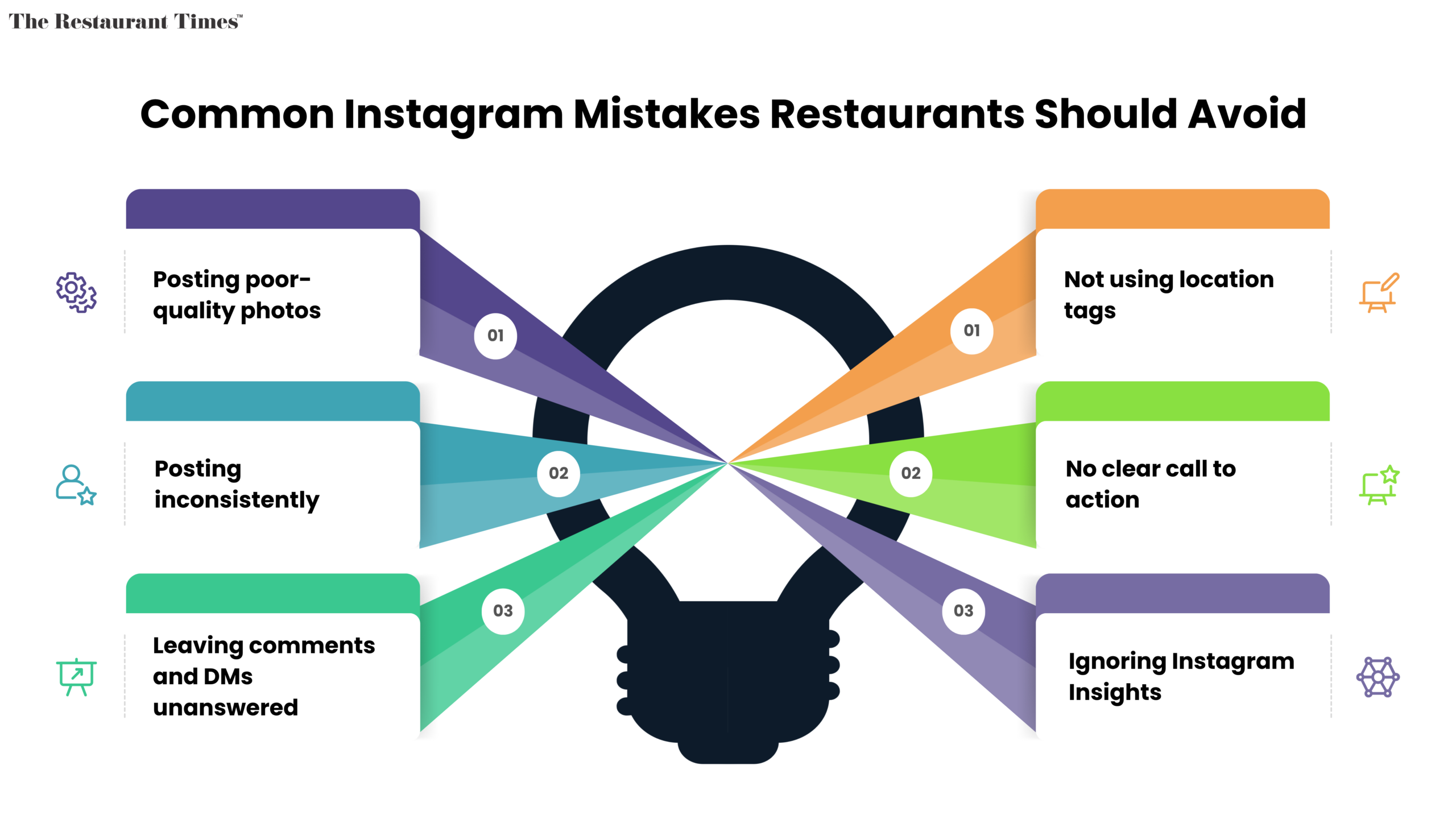
Even the best Instagram strategy can fall flat because of a few mistakes, such as using low-quality food photos, posting inconsistently, leaving comments unanswered, overusing hashtags, not adding location tags, and not including a clear CTA.
Most don’t even track their Instagram Insights and just keep guessing their way up, which rarely works in practice.
KEY TAKEAWAYS
| – Engagement is the lifeblood of Instagram marketing; it signals to the algorithm that your content is valuable, increasing its visibility in users’ feeds. – Encouraging user-generated content and creating a unique branded hashtag can increase foot traffic, customer engagement, and community building. – Key tactics for Instagram marketing include using location tags and leveraging user-generated content by reposting customer photos. – Reposting user-generated content not only saves time for restaurants but also showcases real dining experiences, making customers feel appreciated and involved. – Running a photo contest that encourages guests to tag the restaurant can generate user engagement. – Utilizing Instagram Insights helps determine optimal times for posting to maximize engagement. – Your Instagram profile name should be your restaurant’s name to maximize searchability, and the username should closely resemble the restaurant’s name, using variations if necessary. – A well-optimized Instagram bio should provide a brief introduction to your restaurant, including location, cuisine type, and any special offerings, while also being concise and engaging. – Having a business profile on Instagram is essential for restaurants, as it provides access to features like analytics and allows for more specific designations, enhancing visibility and engagement. – High-quality visuals are essential for restaurants, as it not only makes dishes look appetizing but also reflect the professionalism and care put into offerings. – Mixing educational and entertaining posts with promotional ones follows the 4-1-1 rule: four entertainment posts, one soft sell, and one hard sell. – Instagram Stories can be used to create urgency through flash offers, encouraging immediate action. – Creating visually captivating dishes or photogenic spaces encourages customers to take and share photos. – Reels are a powerful format for restaurants to showcase their personality and engage with audiences through creative, short videos. |
Frequently Asked Questions
1. How much does Instagram marketing cost for restaurants?
If you’re sticking to organic Instagram marketing, i.e., consistent posting, engagement, and UGC, you don’t need to spend even a dollar. You just need a smartphone with a good camera, an internet connection, and your time. If you want to go for paid advertising or influencer marketing, your costs will depend on your goals, target audience, and location.
For starters, you can go with a modest ad budget of $5-$20 per day. For influencer marketing, you can offer interested local influencers a complimentary meal or money as your budget allows.
2. Do restaurants need to hire an Instagram marketing agency?
No, you don’t need to hire an Instagram marketing agency. In fact, many restaurants run really good campaigns in-house with a smartphone, a bit of planning, and a consistent routine. Yes, an agency can help scale things faster, especially for multi-location groups, but it’s not a go-to requirement.
3. What Instagram metrics should restaurants track?
You should track saves, shares, profile visits, link clicks, and direct messages asking about hours, availability, or reservations. These are the metrics that connect directly to real visits and drive customers through your door, and they’re exactly what Instagram Insights is built to show you.