

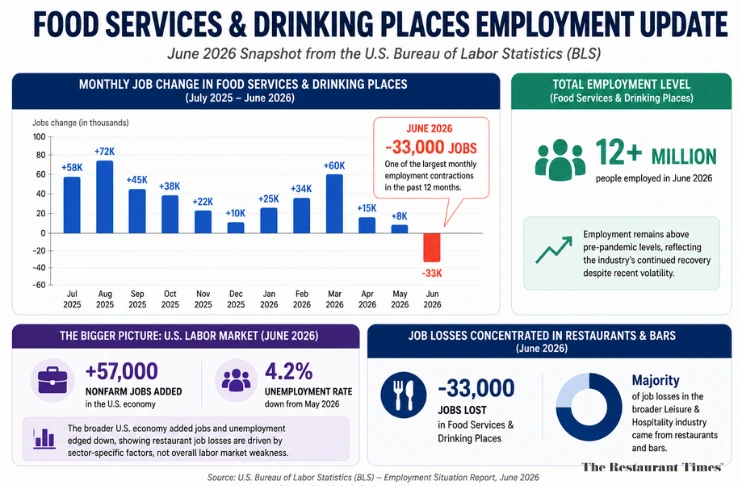

The restaurant industry experienced a slowdown in employment growth in June, underscoring the increasingly cautious operating environment facing foodservice businesses as labor costs remain elevated and consumer spending moderates.
According to the latest employment data released by the U.S. Bureau of Labor Statistics (BLS), the food services and drinking places sector lost 33,000 jobs in June 2026, reversing much of the hiring momentum seen earlier in the year. The decline was among the largest monthly employment contractions recorded by the sector over the past 12 months.
The figures were highlighted in reporting by Nation’s Restaurant News, which noted that restaurants and bars accounted for the majority of job losses within the broader leisure and hospitality industry during the month.
Despite June’s decline, the longer-term employment picture remains relatively stable.
BLS data shows that food services and drinking places employ approximately 12+ million people in the United States, making the industry one of the country’s largest private-sector employers. Employment levels remain above pre-pandemic figures, reflecting the sector’s continued recovery despite recent volatility.
The broader U.S. economy added 57,000 nonfarm jobs in June, while the national unemployment rate edged down to 4.2%, according to the BLS Employment Situation report. The contrast suggests that restaurant hiring is being shaped more by sector-specific challenges than by overall labor market weakness.
For hospitality leaders, the slowdown reflects a changing business environment.
Following several years of aggressive hiring to address post-pandemic labor shortages, many restaurant operators have shifted their focus toward improving productivity, retaining existing employees, and managing labor costs more efficiently rather than expanding headcount.
At the same time, consumers have become more value-conscious amid persistent inflation and higher borrowing costs, prompting operators to carefully balance staffing levels with fluctuating demand.
Restaurants are increasingly deploying self-service kiosks, AI-assisted order management, kitchen automation, and workforce scheduling software to improve operational efficiency. While these technologies are not replacing frontline hospitality roles at scale, they are helping businesses optimize labor deployment during periods of slower traffic.
Quick-service brands have been particularly active in adopting labor-saving technologies, while full-service restaurants continue focusing on scheduling optimization and cross-trained employees.
Labor remains one of the industry’s largest operating expenses.
Labor typically accounts for around one-third of restaurant operating costs, making workforce management one of the most significant drivers of profitability.
The June figures therefore serve as an important indicator for restaurant executives monitoring broader economic conditions.
While one month of data does not establish a long-term trend, slowing hiring often reflects increased caution among operators responding to softer consumer demand, rising operating costs, and continued macroeconomic uncertainty.


