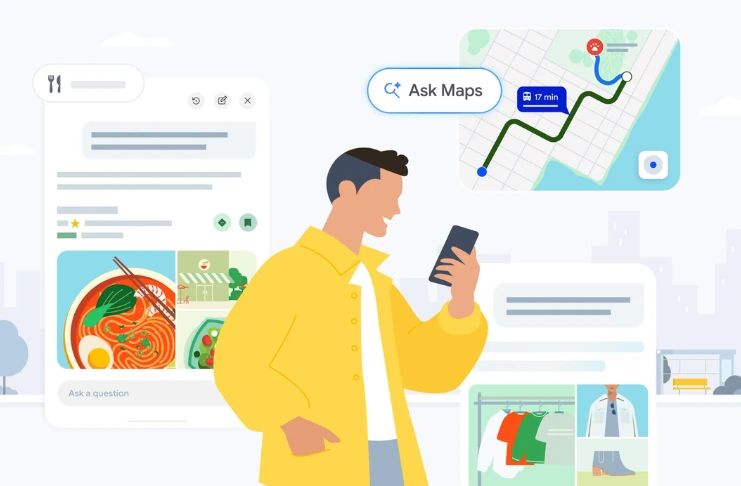

Google is taking another step toward making restaurant discovery and ordering a single experience, allowing customers to find food and build orders through its AI-powered Ask Maps feature without leaving the Google Maps app.
The development, reported by Nation’s Restaurant News, marks a significant shift in how restaurants can be discovered and how digital orders can be initiated. Instead of searching for a restaurant, opening its website or switching to a delivery platform, customers can now use conversational prompts within Maps to find food and begin an order.
For example, a customer could ask Maps to order a pepperoni pizza for pickup on the way home. Ask Maps can identify open restaurants along the route that serve the requested item and factor in information such as saved places and dietary preferences. Once a restaurant is selected, the AI can add the relevant items to a cart, which the customer can then review, edit and complete without leaving Maps.
The capability is being introduced through Google’s Ask Maps, the conversational AI layer within Maps that uses Gemini to answer complex questions about places and local businesses. Google introduced Ask Maps earlier this year as a way to move Maps beyond navigation and conventional search, drawing on information from more than 300 million places and contributions from more than 500 million people globally.
The restaurant-ordering functionality is not yet universal. According to NRN, it currently works with restaurants using online ordering through Square and Toast, while an Uber Eats integration is in development.
That distinction matters for restaurant operators.
Google already provides an Order with Google infrastructure that allows restaurants to surface pickup and delivery ordering through their Business Profiles on Search and Maps. Google says restaurants can work with authorized third-party providers or add custom ordering links to their profiles. Availability varies by market.
The new Ask Maps capability takes that model a step further by putting an AI agent between the customer’s intent and the transaction.
For restaurant businesses, that could make local search optimization, menu accuracy and digital ordering infrastructure increasingly important revenue considerations. A restaurant’s visibility is no longer simply about appearing when someone searches its name. AI systems may increasingly determine which restaurant is relevant to a particular request based on location, opening hours, menu availability, dietary requirements and other contextual signals.