

Restaurant labor costs are one of the biggest numbers on your P&L, and a major expense, second only to food. On average, labor accounts for 25% to 35% of a restaurant’s total sales, which means if you get it wrong even by just a decimal point, you’re hurting your chances of maximum profitability (or maybe even are in the loss, who knows?)
Unlike food costs, however, labor expenses are harder to spot in real time. By the time your monthly P&L arrives, your margins are likely already affected by overstaffed shifts, unexpected overtime, or paying employees during slow hours. Add to it the rising minimum wages, ongoing staffing shortages, and high employee turnover, and keeping labor costs under control becomes even harder.
Knowing how to calculate restaurant labor costs gives you a clear picture of how much you’re spending on employee wages, payroll taxes, and employee benefits compared to what your restaurant earns. How do you do that, though?
This guide will walk you through how to calculate the restaurant labor cost percentage and practical strategies to better optimize your prime cost.
What You’ll Learn
- What are restaurant labor costs & what exact steps should you take when calculating labor costs?
- How do you calculate labor cost percentage?
- Best practices for reducing, optimizing, and managing labor costs
What Are Restaurant Labor Costs & What All Should You Include When Calculating Labor Costs?
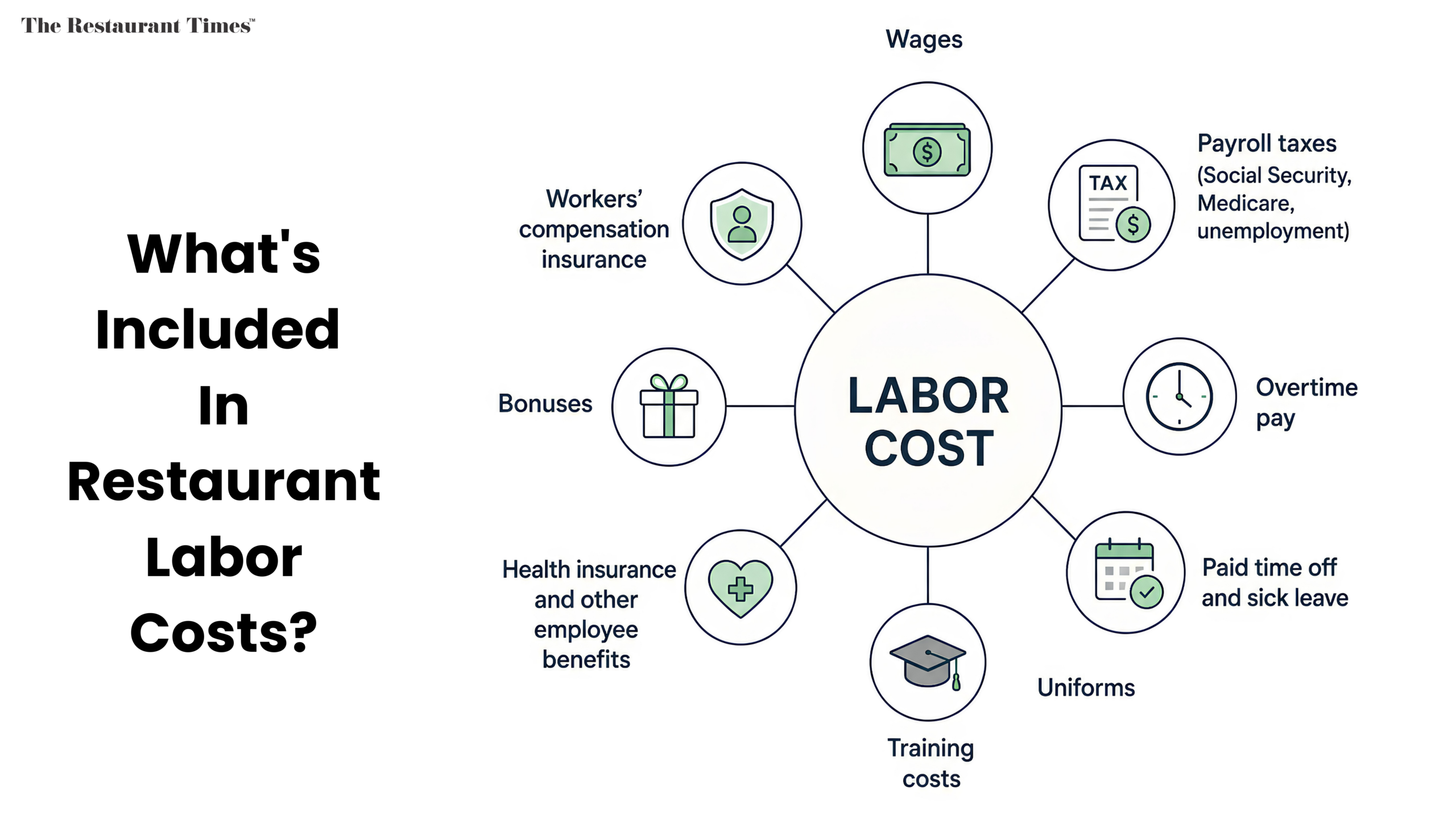
Restaurant labor costs are the total amount a restaurant spends on its people, its workforce. Labor costs in restaurants include wages, overtime pay, employee benefits, payroll taxes, and compliance-related expenses such as workers’ compensation. As motivational speaker Jim Rohn said, “You don’t get paid for the hour. You get paid for the value you bring to the hour.” Since every shift, every role, and every labor hour contributes to the value your restaurant delivers, it’s important for you to account for every staffing expense.
As for why we say that labor is one of the largest controllable expenses for a restaurant, it’s because if you compare it against rent and utilities, which are mostly fixed operating costs, labor and food costs fluctuate based on various factors like scheduling, sales volume, and staffing levels, and so restaurant owners can “control” these “direct costs.”
Now, there’s one thing restaurant operators must know – there are two types of labor: direct and indirect.
Direct labor includes employees who prepare food or serve guests, such as cooks, servers, bartenders, cashiers, and dishwashers. Indirect labor includes roles that support restaurant operations, such as managers, bookkeepers, and HR staff. Both of them count toward total labor costs.
Plus, you will have to bear some hidden labor costs, time and again. This will include:
- Payroll taxes (Social Security, Medicare, unemployment)
- Overtime pay
- Paid time off and sick leave
- Uniforms
- Training costs
- Health insurance and other employee benefits
- Bonuses
- Workers’ compensation insurance, and more.
If you skip even one of these related expenses, of course, your labor budget will look much better on paper than it actually is, and that’s why you must know exactly how to calculate your restaurant labor costs.
How to Calculate Restaurant Labor Costs? 4 Steps to Follow
These are four key steps you need to follow to do your calculations accurately:
Step 1: Find total payroll.
The first step is to add up the gross wages of every hourly and salaried employee, including all hourly pay, for the period you are measuring. Repeating again – Use gross pay, not net pay, since payroll processing withholds taxes afterward.
Step 2: Add taxes and benefits.
Payroll taxes, including Social Security and Medicare, represent a fixed percentage of payroll costs and must be factored into the total labor costs you calculated in the first step. You can use any modern payroll processing tool and accounting software to pull most of this automatically.
Step 3: Calculate total labor expense.
Total labor cost equals gross wages plus payroll taxes plus benefits (like paid leaves and health insurance) plus other employee-related expenses such as uniforms, bonuses, and training.
Step 4: Verify the reporting period.
Make sure your labor expense and your total sales figure cover the exact same period, whether that is a day, a week, or a month.
How to Calculate Labor Cost Percentage?
Once you have followed through step 4, use this formula, which, btw, is a metric many restaurant owners use to calculate restaurant labor cost percentage:
Labor Cost Percentage = (Total Labor Cost ÷ Total Sales) x 100
Let’s take an example:
Your total weekly labor cost = $7,000
Total sales = $25,000
So, labor cost percentage = (7000/25000) * 100 = 28%
Keeping labor costs within the recommended range is essential for your restaurant’s long-term financial health. Many POS systems and scheduling software can calculate labor % almost automatically once payroll data is entered.
What Is a Good Restaurant Labor Percentage?
Labor costs in the foodservice industry generally fall between 30% and 35% of total revenue, with variations based on restaurant type and location. Quick-service restaurants (QSRs) typically target a labor cost percentage of around 25%, while full-service and fine dining establishments often operate with higher percentages due to additional service staff and training requirements.
| Restaurant Type | Ideal Labor Cost % |
| QSR | 25-30% |
| Fast Casual | 28-32% |
| Casual Dining | 28-34% |
| Full Service | 30-35% |
| Fine Dining | 30-38% |
The average restaurant labor cost percentage generally ranges between 25% and 35% of total sales. If labor costs exceed 35% without a corresponding increase in sales, it often forces the restaurant into a loss-making position.
Profitable restaurants must maintain a total prime cost below 60% of total revenue. As far as restaurant types are concerned, full-service concepts incur higher labor costs than fast-food restaurants due to more specialized staffing and service requirements. In 2024-2025, many full-service restaurants experienced median labor costs closer to 36.5%, above the industry standard target range.
Why & How Employee Benefits Affect Restaurant Labor Costs?
Employee benefits, which can include health insurance, paid time off, and retirement contributions, significantly contribute to overall labor costs and can increase expenses by several percentage points depending on the plan and the number of employees.
Ignoring these expenses understates the true cost of employing your staff because, of course, if you calculate restaurant labor costs using just wages, your labor cost percentage will appear lower than it actually is, which will further lead to inaccurate decisions related to budgeting, pricing, and the restaurant’s profitability.
At the same time, benefits can reduce labor costs over the long run, too. Competitive benefits improve staff retention, lowering the recurring costs of hiring, onboarding, and training new employees.
How Does Employee Retention Lower Restaurant Labor Costs?
Employee turnover is expensive. Employee retention strategies can significantly reduce turnover costs, which can be as high as $5,864 per new hire, thereby improving overall labor cost management. Because think about it: every time someone leaves, the restaurant pays again for hiring, onboarding, and training, plus there’s an obvious productivity loss while a new hire gets up to speed. And as Juan Somavia said, “Labor markets are about people. And people have a right to be treated with dignity and respect.”
And that’s why almost every business out there takes (AND SHOULD TAKE) staff retention very seriously.
Lower turnover means fewer hiring cycles, less training time, and a more experienced team that works faster with fewer mistakes, and thus overall a better operational efficiency.
Over time, restaurants that invest in a positive workplace culture and consistent training tend to have a lower labor cost percentage because they don’t have to constantly rebuild their staff from scratch.
How to Use Labor Reports to Spot Operational Issues Early On?
Monitoring productivity by comparing staffing data with sales volume helps avoid overstaffing during slow periods. Consistent labor tracking is thereby central to managing labor costs well.
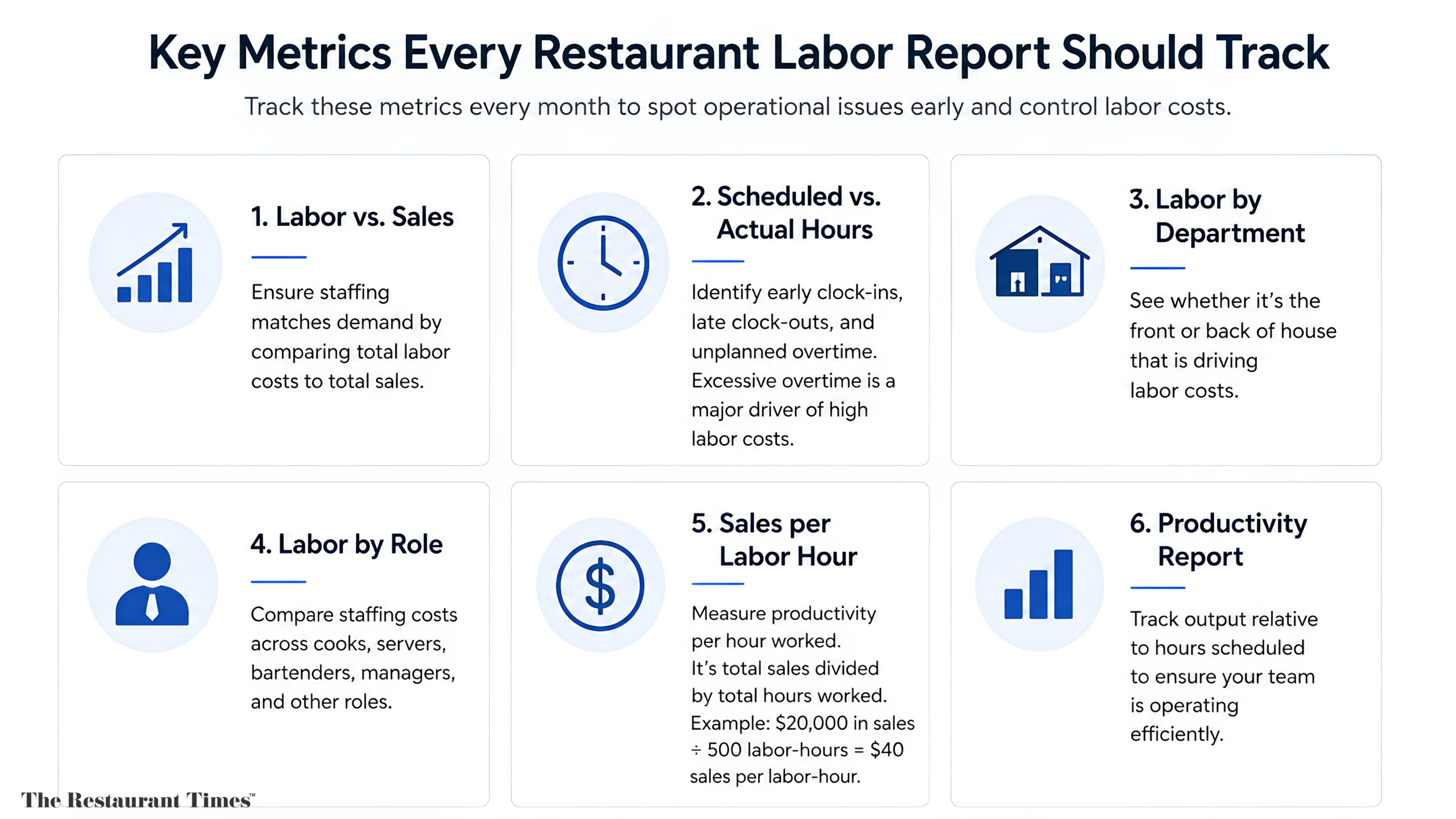
As for what your labor report should track every month, they are:
- Labor vs. sales so as to ensure staffing matches demand.
- Scheduled vs. actual hours to identify early clock-ins, late clock-outs, and unplanned overtime, because, believe it or not, excessive overtime is a major driver of high labor costs.
- Labor by department to see whether it’s the front or back of house that is driving labor costs.
- Labor by role, to compare staffing costs across cooks, servers, bartenders, managers, and other roles.
- Sales per labor hour to measure productivity per hour worked. It’s total sales divided by total hours worked. For example, if your restaurant generates $20,000 in weekly sales over 500 labor-hours, your sales per labor-hour are $40.
- Productivity reports for tracking output relative to hours scheduled.
How Efficient Scheduling Improves Profitability
Smarter scheduling is one of the most effective ways to reduce labor costs, as it allows you to balance the number of staff members you employ per shift without compromising service quality or overstaffing.
Efficient scheduling starts with forecasting demand from historical sales, weather, and local events. Once demand is predictable, managers can create schedules that align staffing with expected customer traffic over the forecasted period.
Some of the best practices include:
- Using split shifts to match staffing to actual rush periods
- Avoiding overtime by tracking hours in real time
- Cross-training employees so one person can cover multiple stations, which also supports operational efficiency and high-quality service during a rush.
- Using AI scheduling tools that learn from past sales patterns
- POS integration, so it’s much easier for scheduling software to pull sales data directly
If you can manage schedules around actual sales and cut unnecessary shifts during slow periods, you can easily control your labor costs. Plus, implementing modern restaurant technology, such as automated scheduling tools and digital ordering platforms, can improve efficiency and reduce manual tasks, ultimately lowering labor costs.
10 Practical Ways to Control Labor Costs
Keeping labor costs under control isn’t about making one major change. It comes down to how consistently you’re improving how you staff, schedule, and manage your workforce.
For reducing labor costs, you can start using these 10 ways ASAP:
#1: Forecast demand accurately by using historical sales, weather, events, and seasonal trends to align staffing levels with expected customer traffic.
#2: Schedule employees based on projected sales to ensure every shift has enough staff to maintain service.
#3: Track labor costs daily to catch overstaffing, overtime, and productivity issues before they affect your monthly P&L.
#4: Keep overtime under control by monitoring employee hours in real time and redistributing shifts accordingly.
#5: Review labor performance reports such as labor vs. sales, scheduled vs. actual hours, and sales per labor hour to identify inefficiencies early.
#6: Cross-training employees allows for operational flexibility and can help maintain service levels with fewer total staff members, reducing labor costs.
#7: Automate routine workforce management with POS-integrated scheduling, payroll, and time-tracking software to reduce manual work and scheduling errors.
#8: Invest in onboarding and continuous training so employees become productive faster, make fewer mistakes, and require less supervision.
#9: Simplify menu operations by reducing unnecessary prep complexity and standardizing processes to lower kitchen labor requirements.
#10: Prioritize retaining employees through competitive pay, benefits, recognition, and career development.
💡Remember: Labor costs will always be one of your biggest operating expenses, but they don’t have to be a challenge per se. Once you start tracking them consistently, scheduling around demand, and reviewing performance data regularly, you’ll be in a much better position to make smarter staffing decisions.
KEY TAKEAWAYS
| – A standard target for restaurant labor cost percentage is 20–35% of revenue, with 25–30% being common for many establishments. – Wages paid to employees are the core of labor costs, encompassing both hourly wages and salaries for full-time and part-time staff, with overtime pay potentially increasing these costs significantly if not managed effectively. – To calculate your restaurant’s payroll percentage, divide your total payroll costs by your total revenue using the following formula: Total Payroll Costs ÷ Total Revenue = Restaurant Payroll Percentage. – The labor cost percentage is calculated by taking the total labor costs and dividing them by total sales, then multiplying by 100 to get a percentage. – A good labor cost percentage for restaurants typically ranges from 25% to 35% of total sales, depending on the type of restaurant and service level. – The typical target for labor cost percentage in restaurants is around 30% of gross revenue, with many establishments aiming for a range between 25% and 35%. – Full-Service/Fine Dining can have labor costs of 30% to 35%+. – Casual Dining typically has labor costs between 25% and 30%. – Quick-Service Restaurants generally have labor costs between 20% and 30%. – Efficient scheduling and forecasting busy times can help keep labor costs in check. |
Frequently Asked Questions
1. How does restaurant location affect labor cost percentage?
Location has a major effect on restaurant labor cost percentage because minimum wage and cost of living vary by state and city. Take California, for example. In April 2024, California raised the federal minimum wage for fast-food workers to $20 per hour, significantly increasing labor costs for quick-service restaurant operators across the state.
As of January 2024, 25 states have implemented minimum wage increases, contributing to rising payroll costs across the restaurant industry. This is how Regional variations in minimum wage and cost of living directly affect payroll percentages, with California having the highest payroll percentage at 28% of revenue due to high employee wages and regulatory changes. Of course, different rules and labor laws apply to other states and thus affect labor costs.
2. Should the labor cost percentage be calculated daily, weekly, or monthly?
Ideally, you should track labor cost percentage on all three time frames. Daily tracking will help catch overstaffed shifts immediately. Weekly tracking shows trends across the schedule. Monthly reporting helps with accounting, but on its own, it is too slow to catch problems.
3. Why is my restaurant’s labor cost percentage so high?
Your restaurant’s high labor cost percentage might be due to one or more of these causes:
- Overstaffing relative to sales
- Uncontrolled overtime hours
- High employee turnover, or
- Drop in sales while the schedule stayed the same.