

The harshest reality of working in the restaurant industry is that it looks and feels so exciting, being your own boss, cooking yummy food, feeding millions, and making a lot of money doing what you’re mostly passionate about until you actually step in and realize how so many restaurant owners are constantly on the edge, dealing with negative margins.
What people don’t really get is that you can’t just open an outlet at a random location with a so-so concept and expect people to naturally come knocking.
To have a near-decent restaurant profit margin, you have to have a really good concept, it must be at a really ‘hot’ location, and you have to deal with labor costs, food costs, and many other operating costs (both fixed costs and variables).
Now, the question is, how do you do that – how do you protect your restaurant margins, your bottom line? This guide answers the exact.
What You’ll Learn
- How to calculate your restaurant’s gross and net profit margins.
- Factors that impact restaurant profitability and how to fix them.
- Practical ways to increase profits and improve your restaurant’s financial health.
What is Profit Margin in a Restaurant?
“After paying every bill, how much money do I get to keep?” – That’s your profit, as simple as that.
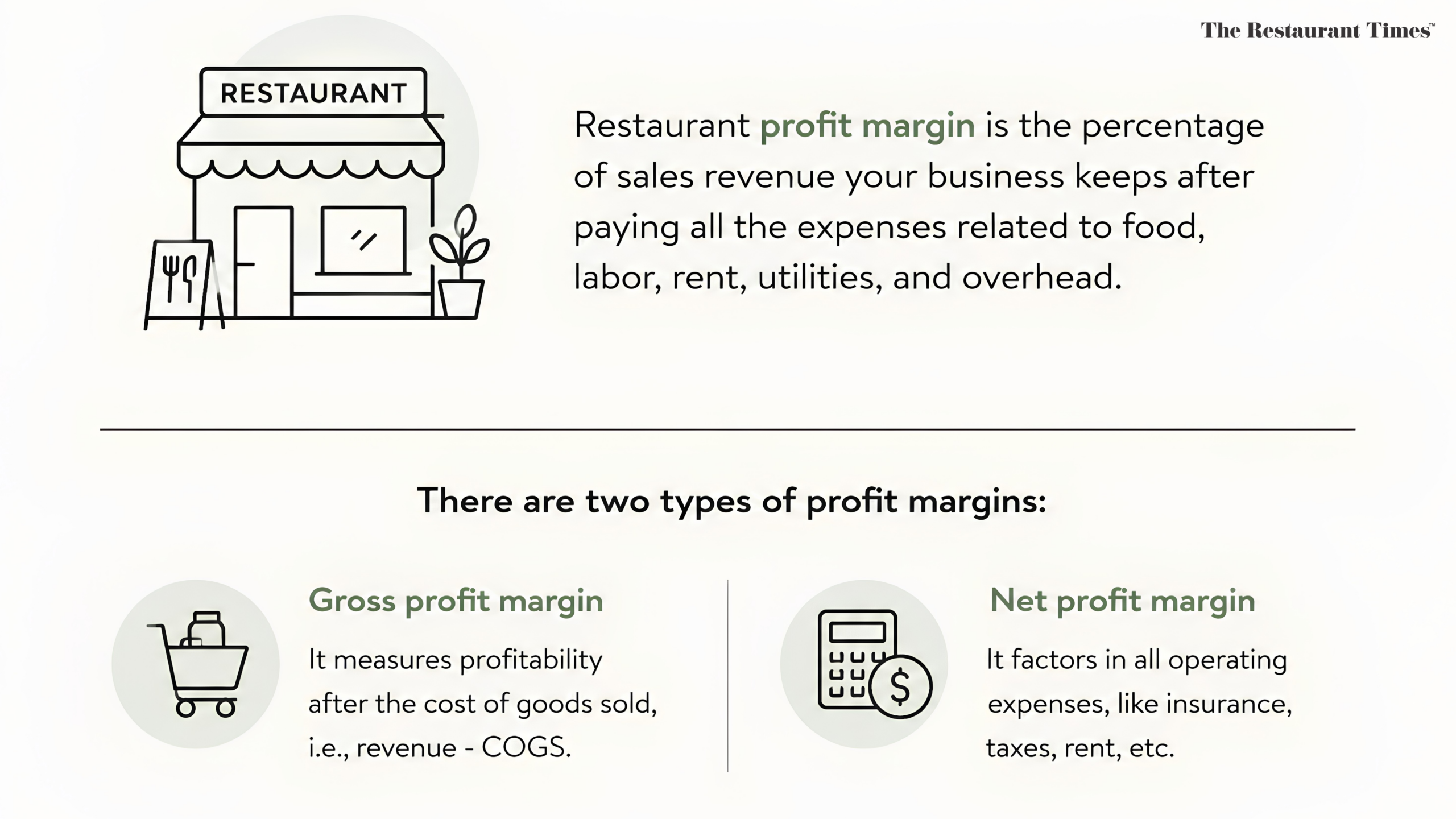
But if you really wish to get into theory, then restaurant profit margin is the percentage of sales revenue your business keeps after paying all the expenses related to food, labor, rent, utilities, and overhead. It’s a standard measure of the business’s profitability, or the potential to make a profit, and for most independent restaurants, that number is around 3-5%. The higher this margin, the more efficiently your restaurant business is managing its resources.
If you want to achieve a really good profit margin, you need to be super disciplined about cost control and consistent execution because, at the end of the day, how much profit you keep depends less on how much you sell and more on how tightly you control costs, and that’s the core idea behind every restaurant profit margin calculation in this guide.
That said, there are two types of profit margins:
- Gross profit margin – It measures profitability after the cost of goods sold, i.e., revenue – COGS.
- Net profit margin factors in all operating expenses, like insurance, taxes, rent, etc.
Since major factors influencing restaurant profitability include food costs, labor costs, and rent or occupancy costs, they have a really big impact on every dollar that comes in, and thus, calculating both gross and net profit margins helps restaurants benchmark performance, guide pricing decisions, and identify opportunities to improve long-term profitability.
How to Calculate Restaurant Profit?
To calculate your restaurant’s profit, you need 2 figures:
- Total sales revenue
- Your total operating expenses
With these, use these formulas:
Gross profit margin formula – Gross profit margin is calculated as (Revenue – Cost of Goods Sold) ÷ Revenue × 100, zeroing in just on food and beverage costs relative to sales.
Net profit margin formula – Net profit margin is calculated as (Revenue – All Expenses) ÷ Revenue × 100, accounting for all operating expenses, including labor, rent, and utilities.
Here’s an example to help you understand better:
Say your restaurant brings in $150,000 in total revenue over a month, with $138,000 in total expenses across cost of goods sold, labor, and overhead. Then,
Total Revenue – Total Expenses = Net Profit
$150,000 – $138,000 = $12,000
($12,000 ÷ $150,000) x 100 = 8%
Mind that we haven’t yet discussed how restaurant type influences this margin, so we’ll assume you were running a full-service restaurant, and with 8% margin, you’re well above the industry average of 3-5%, which is a good sign.
What Is the Average Restaurant Profit Margin?
The average depends on the source and the restaurant type you’re looking at. As for the industry benchmarks:
The typical net profit margin for a restaurant ranges from 3% to 9%. On average, restaurants retain just 3-5% in net profit after covering other expenses, which is why many restaurants struggle to remain profitable even when sales look healthy on the surface.
A healthy net profit is the real test of a restaurant’s business model, but again, there are a lot of discrepancies around this range.
For example, according to research from New York University, the average restaurant profit margin in 2024 was 10.62%, notably higher than most industry reports. On the other hand, Charlie Anthe, who is a restaurant Industry Analyst, mentions in his review of surviving restaurants that between 2014 and 2018, average profit margins fluctuated between just 1.8% and 6.1% year-round. Chains with centralized purchasing often report a higher average profit margin than independent operators facing the same local costs.
Kevin Bryla, a client services executive who has studied inflation’s impact on dining in depth, has pointed out that “the fluctuating market will continue to present challenges to maintaining a healthy profit margin,” and that is why he and many professionals in the field time and again suggests tracking your own numbers than blindingly comparing against the industry-wide average that may not even stand for your concept, city, or cost structure. Industry surveys suggest the average profit margin for delivery-only concepts continues to climb as commission structures evolve.
What are the Key Factors That Affect Restaurant Profitability the Most?
You must have heard of the 30/30/30 rule a lot of times. It says that of the majority of restaurant expenses, 30% goes to food, 30% to labor, and the next 30% is for overhead.
Labor and food costs are typically the largest controllable expenses for restaurants, often accounting for 60-70% of total revenue, making it critical to monitor scheduling, inventory, and waste. Rent and occupancy costs account for another meaningful share of total revenue.
Labor Costs
Labor is generally the second-largest expense in a restaurant, consuming about 30% of revenue, which includes wages, salaries, overtime, payroll taxes, and benefits like healthcare or paid time off. Labor typically eats up close to a third of total revenue, which is why scheduling software has become non-negotiable.
Implementing smart scheduling technology can help restaurants reduce labor costs by matching staffing levels to projected sales, ensuring that restaurants are neither over-staffed nor under-staffed during peak hours. You should pay special attention to turnover here because every employee who leaves the job means you’ll have to bear the cost of hiring and training all over again to bring in a replacement.
Food Costs
Food costs, also called cost of goods sold, are the direct cost of every ingredient you use to prepare your dishes. High food waste and spoilage shrink profit margins really quickly. Food and beverage costs alone can eat up nearly a third of total revenue if inventory isn’t tightly managed.
Effective food cost management can improve restaurant profit margins by 2-4%, which is significant in an industry where profit margins are typically single-digit. Plus, reducing food waste can significantly improve profit margins, as food costs represent approximately one-third of a restaurant’s revenue, and data says that for every $1 invested in reducing food waste, restaurants can save an average of $6. Composting programs and portion audits are two more underused ways to reduce food waste.
How Different Business Model Choices Affect Profitability
The kind of business model you have sets both the ceiling and the floor for what restaurant profit margin is realistically achievable. For example, understand it this way:
Full-Service Restaurants vs. Quick-Service Restaurants
Full-service restaurants typically see profit margins of 3-5%, while fast casual and quick-service restaurants tend to have higher margins in the 6-9% range. This doesn’t mean seating restaurants aren’t as profitable; it just means that in that setting, you have to deal with higher labor costs that come with table service, larger waitstaff teams, and a more involved guest experience in general. Full-service restaurants operate with higher staffing needs than their quick-service counterparts.
Fast-casual restaurant profit margins range from 6% to 15%, largely because there is a counter service and a very simplified restaurant operation, and so, of course, labor costs are relatively lower, and table turnover is much faster.
Then there are other formats like cafes, which generally have profit margins ranging from 2.5-15%, often due to their focus on specialty coffee and light meals, which can be priced at a premium. Food trucks and catering businesses benefit from lower overhead costs, and ghost kitchens, which operate on a delivery-only model, can achieve profit margins of 10-30%, significantly outperforming traditional restaurant models. Food trucks also benefit from the flexibility of moving to wherever demand is highest that day. Many catering businesses report steadier margins than traditional dine-in restaurants because of pre-committed order volumes. Shared kitchen models and smaller footprints both lead to lower overhead costs, which is one reason ghost kitchens post such strong numbers.
Again, at no point are we saying that one business model is objectively better than another. It’s just whatever you choose; you must have clarity of what your margin structure may look like (once again, this is just a benchmark, and there is no universal guideline that your restaurant has to have to fall within the range to be “considered” even remotely profitable). Because at the end of the day, almost every conversation around restaurant profit margin comes back to the same three levers: food cost, labor cost, and pricing.
How Can You Leverage Menu Engineering to Increase Your Average Profit Margin Even Further?
Menu engineering, or sometimes called menu psychology, is the deliberate use of data and design to steer guests toward your most profitable dishes. Like “I want my guest to order X, so I am going to put it right where they look first.”
Effective menu engineering and pricing impact profitability by optimizing high-margin items and reducing costs. How do you do that? There are three steps:
- Pull sales data on every item on your menu.
- Now, sort those dishes into four buckets:
- Stars (These are the most profitable dishes + are very popular – crowd favorite)
- Cash cows (These are very popular, but make lower profit in comparison)
- Puzzles (These are profitable but less popular)
- Dogs (Low profit and low popularity items)
- Decide on the placement and visual emphasis on the menu for each bucket. Of course, you’d want to promote stars and cash cows more, so make them more noticeable. As for the dogs, we’d suggest you either adjust your prices, rework the recipe, or maybe even consider removing them altogether. Every dish’s selling price should be reverse-engineered from your target margin.
Modern POS systems now automatically calculate food costs and track item performance, making menu optimization accessible to operators of all sizes. Here, tracking gross profit by category especially helps you spot which menu sections are actually pulling their weight.
How Can You Decrease Expenses & Build a More Profitable Restaurant? 12 Ways!
Let’s keep this to the point:
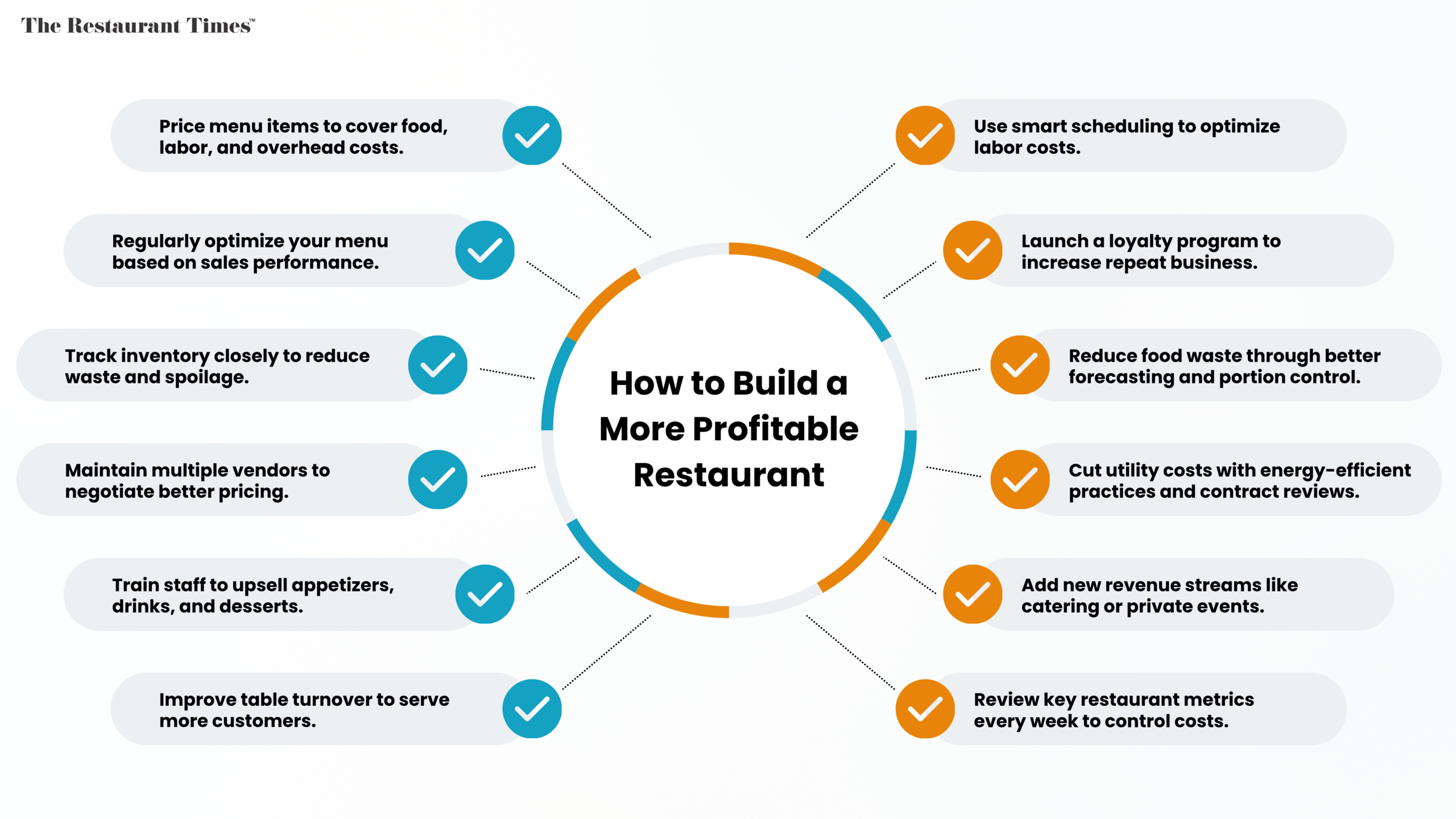
#1: Tip 1 is to price your menu around total cost and not just the food cost. Meaning, your menu prices should cover labor and overhead, too. Even a slight increase in menu prices can meaningfully affect your bottom line.
#2: Take menu engineering very seriously, and since sales patterns fluctuate with seasons, you should keep reassessing your stars and dogs accordingly. Savvy restaurant owners track their numbers weekly… It’s time you were counted in that category, too.
#3: Tighten your inventory management. Track inventory, waste, and spoilage by station and shift so you can catch small issues on the spot.
#4: Keep two or three reliable vendors as your backup so you’ll have better chances of negotiation when market prices increase, and in case there’s a supply chain issue. However, remember this one thing: Vendors want to know your total sales trends before they agree to better pricing terms.
#5: Train your staff to upsell naturally. They should be able to recommend appetizers, drinks, sides, or desserts alongside mains so as to increase revenue and your overall average check.
#6: Improve table turnover by serving customers with utmost care and respect. It will allow you to seat more customers during busy hours and generate more revenue from the same number of tables. But first, estimate how many customers you actually need each night to break even.
#7: Invest in scheduling technology. Implementing smart scheduling technology solutions can help restaurants reduce labor costs by matching staffing levels to projected sales and ensuring sufficient staffing during peak hours. This is really just a proxy for operational efficiency – the tighter your operations, the more of every dollar you keep.
#8: Launch a loyalty program to encourage repeat visits, which is, btw, much more profitable than constantly acquiring new customers. A well-run loyalty program also gives you first-party data on customer habits, which comes in really handy when you’re deciding on promotions, scale, and more.
#9: Be very deliberate in your efforts to reduce food waste. You can try portion control, accurate forecasting, and demand-based purchasing. Accurate forecasting helps you meet customer demand without overordering perishable inventory.
#10: Keep an eye on utility usage. Restaurants consume significant amounts of electricity, gas, and water, so investing in energy-efficient equipment can reduce operating costs over time. You can also try renegotiating vendor contracts to decrease expenses.
#11: Try your hand at catering services, meal kits, private events, or branded merchandise as an additional revenue stream. Not every restaurant can raise prices, so increasing sales volume is often the only reliable way out.
#12: Once again, and we can’t emphasize enough – Track your numbers every week. Monitoring key metrics such as menu item sales, traffic patterns, and utility usage can help protect against runaway expenses and improve overall profitability and decision-making.
INDUSTRY INSIGHT
| Pricing their menu accurately is one of the key challenges operators have been facing lately. Bain & Company’s 2026 analysis notes that restaurant prices have climbed considerably faster than grocery prices, pushing more diners to cook at home and forcing operators to rethink their value proposition. |
What Common Mistakes Do Most Restaurants Make That Hurt Their Chances of Securing Higher Margins?
The biggest mistakes restaurant owners/operators make when dealing with money or calculating their margins are:
- They price their menu items without accounting for overhead and other operating expenses, which leaves them on their own to cover those costs out of their pockets. (That’s what we meant when we opened the article talking about negative or thin margins) A thin restaurant profit margin often has less to do with sales and more to do with unmonitored waste.
- They underestimate third-party delivery commissions. Andrew Rigie, Executive Director of the NYC Hospitality Alliance, said: “Some restaurateurs told me that they lose more money on individual orders because Grubhub charges a 15% to 30% fee on the total order amount, which is higher than their restaurant’s profit margin.” What a bad way to lose money, no?
- They focus only on profit margins and ignore cash flow, and then later, struggle to pay bills when they come due. A rising gross profit number doesn’t always mean a rising net profit as well; more often than not, overhead eats into the difference.
- They spend more on acquiring new customers than on bettering their relationship with existing loyal customers.
- They assume business will stay consistent throughout the year and don’t track their net profit weekly, when in reality, restaurant profit margins naturally fluctuate with seasonality, tourism, weather, and local economic conditions.
How many mistakes are you making? It’s time you get them right and see your gross profit margins (and net income) soar. Improving your restaurant profit margin rarely requires a single big fix – it’s usually a dozen small ones compounding together. Cash flow problems, not lack of popularity, are the reason most restaurants close within their first few years.
KEY TAKEAWAYS
| – The average profit margin for full-service restaurants typically falls between 3% and 5%, while fast casual and quick-service restaurants generally see margins ranging from 6% to 9%. – Restaurant profit margins can vary significantly, typically ranging from 0% to 15%, with the average being around 3% to 5%. – Cafes generally have average profit margins ranging from 2.5-15%, often due to their focus on specialty coffee and light meals, which can be priced at a premium compared to full-service restaurants. – Restaurant expenses generally follow the 30/30/30 rule: 30% for food costs, 30% for labor, and 30% for overhead. – Restaurants that consistently monitor their metrics, such as menu item sales and utility usage, tend to outperform industry averages, enabling better decision-making regarding cost management. – Technology implementation has shifted from optional to essential for competitive restaurant profit margins, with restaurants that adopt these technologies typically seeing payback periods of 6-18 months and ongoing margin improvements. – Most restaurants operate on such thin margins that a single bad month can wipe out a whole quarter’s gains, which is exactly why weekly tracking matters more than annual reviews. – For most operators, hitting a good profit margin means treating every cost line item as negotiable. Marketing and delivery fees combined often nibble away another 5-10% of total revenue, so it pays to review those contracts as closely as your food invoices. |
Frequently Asked Questions
1. How does restaurant profit margin vary by location?
Location affects nearly every input into your profit margin, from local rent and labor costs to competition and spending habits. A restaurant in a high-rent urban area needs a higher average check or faster table turnover just to match the margin of a similar concept in a lower-cost market. Seasonal tourism and local economic conditions can also cause a much more visible margin variance across locations. The average restaurant runs on razor-thin margins, which is why small inefficiencies compound so quickly.
2. What should I do if my restaurant doesn’t meet the 30/30/30 rule?
If your restaurant doesn’t meet the 30/30/30 rule, identify which cost category is exceeding 30% and address it directly. Reduce food costs through better inventory management and menu pricing, optimize labor with smarter scheduling, or cut unnecessary overhead expenses. If costs can’t be reduced further, focus on increasing sales volume to improve your overall margins.
And, and, and remember this very clearly: the 30/30/30 rule is just a guideline, not a requirement you have to stick to at all costs.