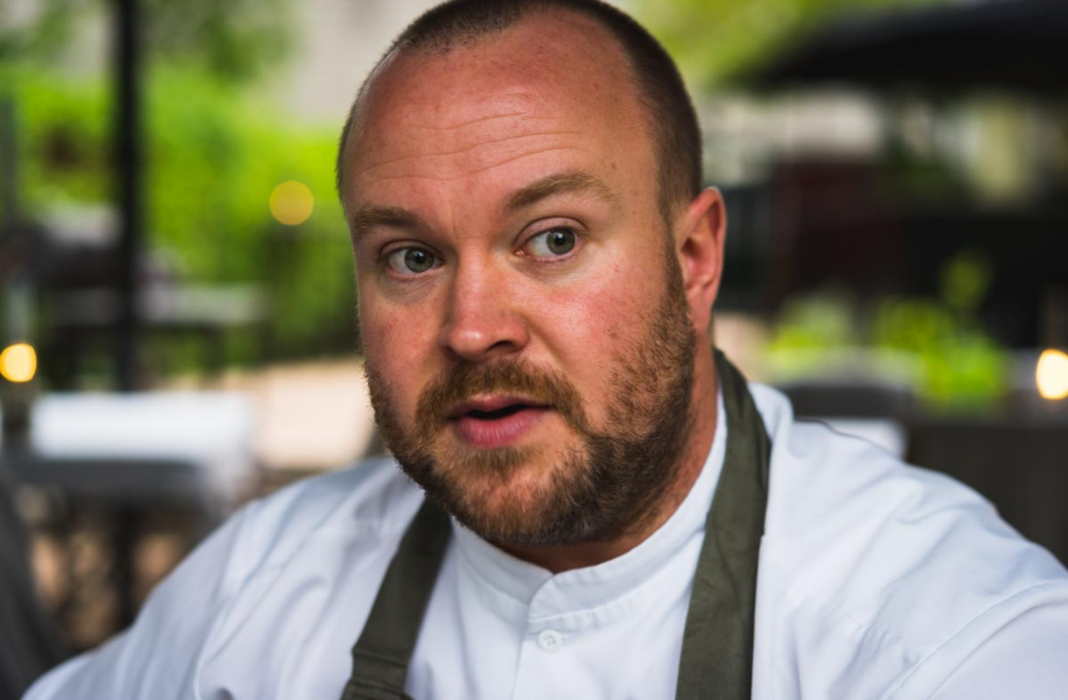

“Gastronomy is closely linked to the place where we are.” Daniel Berlin shares how at Vyn, his restaurant, which is on the Österlen coast in Sweden, every decision circles around the landscape itself. The Baltic Sea, the surrounding fields, the changing seasons, and the ingredients they yield are ultimately THE menu. “It’s all about this, sea and land,” Berlin says. “I feel safe and clear in what I do. I’m not so searching in my gastronomy.”
To be precise, Vyn is on the east side of Österlen, right between Skillinge and Brantevik, about 100 meters from the water, in the Skåne countryside where Berlin was born and still lives.
He closed his previous restaurant, Daniel Berlin Krog, in September 2020 for family reasons, after two Michelin stars and years of acclaim.
The reopening, three years later, was, of course, one of the most anticipated returns in Nordic gastronomy, and it came with sky-high expectations.
A Barn, A Hotel, & The View
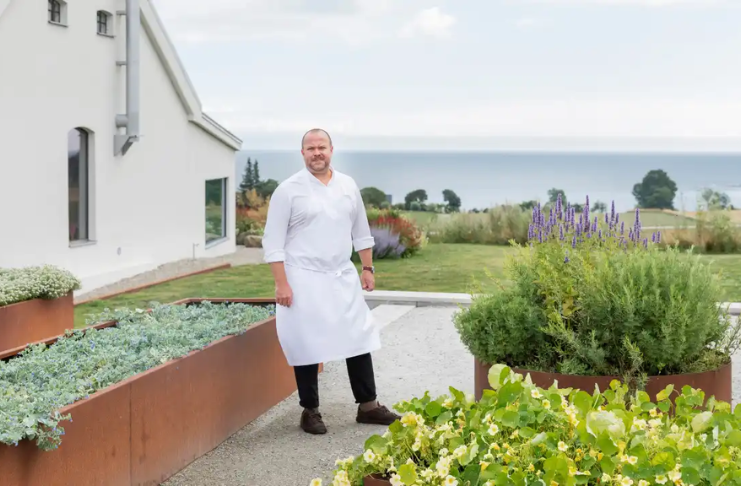
Vyn means “view” in Swedish, and the name, in a way, does justice because the restaurant building itself was formerly a stable and barn, converted into a restaurant with 15 hotel rooms, a kitchen garden, and a greenhouse that recently became a cocktail bar. The old dwelling houses the Food & Wine Bar, a more relaxed space serving light meals and breakfast to hotel guests.
Interior designer Lisa Mannheimer of the architecture firm Fojab Arkitekter worked with Berlin to turn the space into what she calls a connected whole, built around keywords like Scandinavian, local, craftsmanship, and natural materials. The long, wide-planked wooden floors, treated with a natural hard wax oil, were chosen partly for how they sound underfoot. Mannheimer felt they gave the room something robust and exclusive at once.
Berlin describes the intention behind the whole project as “a place where you can enjoy fantastic gastronomy in a beautiful setting. A place where you can relax, get a break from the hustle for a while, and recharge. A place where you can just be.”
The restaurant opened on October 25, 2023. The following year, it earned two Michelin stars and was named the world’s best newly opened restaurant at a gala in Paris. In 2025, it got to 47th on the World’s 50 Best Restaurants list, and earlier last year, it was one of only nine restaurants across the Nordic and Baltic countries to score a perfect 100 points at the Falstaff Nordic Awards.
None of that, Berlin insists, was the plan going in. “It’s not that we’ve said we’re going to be three-star; we’re doing what we’re doing and hopefully getting a little better during the journey. It’s easy to start running and forget about the daily grind.”
A Kitchen Built on What the Land Gives
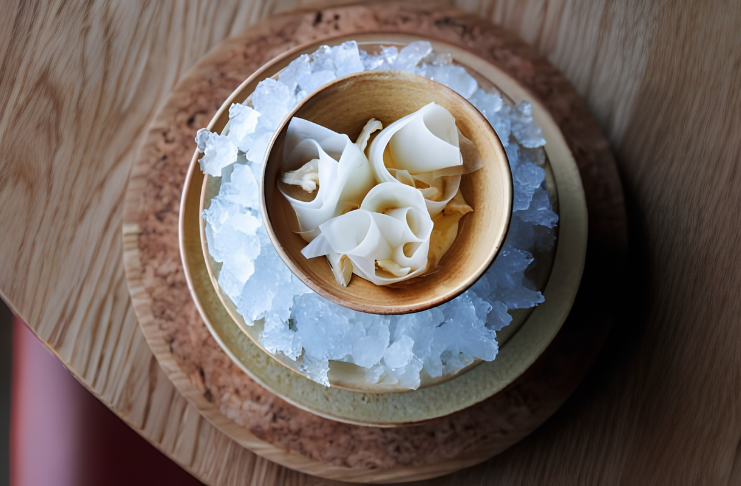
The tasting menu at Vyn runs to roughly 16 courses, built nose-to-tail from ingredients that are foraged, grown, or hunted from the surrounding fields, forests, and coastline.
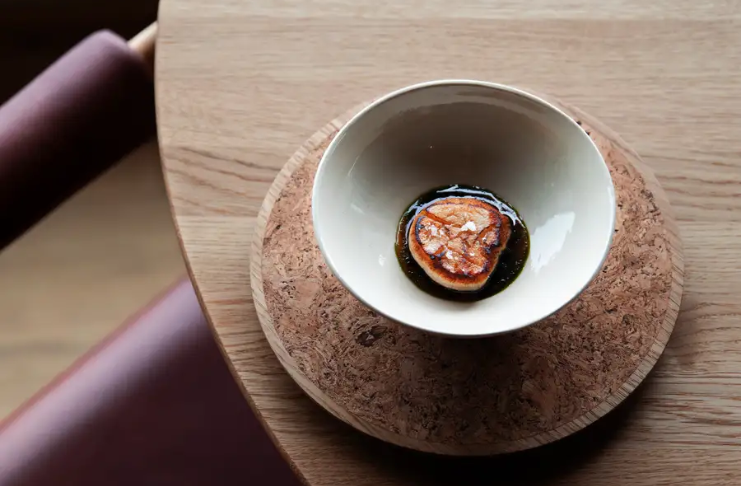
You’ll almost always see warm king crab, butter-poached langoustine, and Kalix löjrom on the menu. One of the most talked-about dishes here is scallops served with apple juice and sugar kelp, one half seared hot and crisp, the other kept ice cold, plated together so the contrast hits in a single bite.
Berlin’s cooking has often been filed under New Nordic cuisine, which means it is built around ingredients kept close to their source and season. He says, “You can’t ignore the seasons. I can long all year round for all the greens that are finally ready to be harvested in the summer.”
Availability, in other words, is not a constraint he works around. It is the structure on which the whole menu is built.
As far as temperature and texture are concerned, it’s something “you can’t cheat with. The hot food should be smoking when it’s served. That the food is cooked for you, that it becomes personal and close, is super important.” Berlin believes every dish must arrive exactly as it left the pan, because immediacy is part of what is served at Vyn.
That same logic applies to how the kitchen treats its raw materials, right down to who’s handling them. Berlin often asks the younger cooks whether they know the price of the fish in front of them. “I think it is extremely important to have respect for the raw materials.” It’s a habit that turns cost into a kind of shorthand for care, a way of making sure nobody in the kitchen forgets what they’re actually holding.
Sustainability at Vyn runs through how the restaurant and the more casual Food & Wine Bar share a single supply chain. “If we use the loin of a fish in the restaurant, the tail pieces go to the Food & Wine Bar, which means that we can serve high-quality food at a good price level there.”
Everyone in the Kitchen is Zlatan
Berlin is in the kitchen himself all four days a week that Vyn is open, cooking and greeting guests at the door. The dining room seats 30 across ten tables, with a separate chambre séparée called the Studio that holds 24 more.
On a full night, the kitchen runs on high intensity. Berlin sums up in one line: “In the kitchen, everyone is Zlatan.” It’s a comparison to Sweden’s most famous footballer, where each person is fully switched on, aware of their station, and not needing to be told twice.
He values the range of backgrounds his staff brings to the table. “Everyone in our staff comes from different places and has different experiences, which in turn means that we have staff who are also suitable for meeting all kinds of guests, both those who eat at star restaurants every day and those who do so for the first time in their lives. And when a guest returns, you have succeeded.”
Reading this, you’d think how passionate Berlin must be about making a career in hospitality for long enough, but interestingly, Berlin didn’t have any passion for food. He struggled to sit still in school, gravitated toward music and pictures, and only signed up for the chef program because it meant two days a week outside the classroom.
What he eventually liked about the field was team sport, the pull of doing something alongside other people. He recognized that energy in a kitchen and committed to it fully. “If I get hooked on something, I go all the way. I wanted to become a really skilled chef and focused on that, and therefore quit hockey.”
The path from there ran through Petri Pumpa in Malmö, then Guldapan in Stockholm, then back to Skåne as head chef at Torso Twisted in Malmö’s Turning Torso. Three years later, he took over Brummer’s restaurant in Skåne-Tranås and named it Daniel Berlin Krog, earning his first Michelin star in 2016 and a second in 2018. He closed it in 2020. Vyn, three years on, is not a sequel so much as a return to the same coastline with a clearer sense of what he wants the place to give people.
“Today, my great passion is not as much running a hotel and restaurant as cooking,” he says.