

You know what – be it rent, labor, or the cost of good -quality coffee beans – everything’s on the rise, but still, how unfortunate that customers don’t understand this. Even if they do on paper, they would rather go to your competitor than buy a latte that suddenly costs a few pennies more.
And if you thought that you’d look up signature coffee drinks & high margin ideas online and start selling them at your coffee shop too, let me tell you -what these ideas promise vs. what ends up in your pocket at the end of the day can’t be further apart.
Now, the question is: even after all these rising costs, how can you still create a profitable beverage menu for your cafe? This article discusses exactly that.
What You’ll Learn
- How can you identify high-margin coffee drinks and price them for better profitability?
- Profitable drink ideas you can play around with in 2026.
The Math Behind High-Margin Drinks
First, let us agree on one definition of what “high margin” means for a coffee shop.
See, just like food cost percentage, we have a term called beverage cost percentage, and it is direct beverage cost (cost of making) divided by its selling price, times 100.
Similarly, we have gross profit per serving, which is the selling price minus the cost. This doesn’t account for rent and labor.
If you go by industry standards, many operators target beverage gross margins of around 65-80% before labor and occupancy costs.
How do you maintain such high margins, though? By effective beverage cost management. See this example: let’s say, from all the drinks on your coffee menu, a latte sells for $5 and costs $1.25 in ingredients. When you do the calculation using the formula above, beverage cost percentage will come to be around 25%, gross profit per serving $3.75, and gross margin 75% before other operating expenses.
Basically, to maintain a high margin, you focus on three key things –
- Ingredient cost
- Portion control
- Your pricing strategy
Apart from ingredient costs, you should also account for waste, recipe consistency, and preparation time to gauge if a particular drink is actually profitable or not.
INDUSTRY INSIGHT
| More than one study points towards the rising demand for cold coffee these days. In fact, 70% of US coffee sales trace back to cold beverages. Plus, 68% of Gen Z consumers prefer cold coffee year-round. These demands show up in how operators price such drinks as well. Like, a 16-ounce iced latte averages around $5.59 against its 12-ounce hot counterparts, which average $5.44. Recent café trends also show interest in cold foam, flavored syrups, and highly customizable beverages. But here’s a catch – higher selling price may not mean high margins too. With every extra topping, milk, and syrup, you increase your ingredient costs too, and the portions become oversized, and preparation is inconsistent. Plus, because cold brews have long steeping times, cafes must prepare batches in advance, allocate storage for them, and forecast their demand. If you produce too much, unsold coffee will end up as waste. If you produce too little, how are you gonna manage peak hours? What’s the solution, though? The smarter approach is to cost each cold beverage recipe individually, standardize portions, and track sales alongside gross profit per serving. |
Signature Drinks and Cold Brew Worth Putting on Your Menu
When it comes to signature drinks, the goal is to create something people would talk about – both offline and online, and while you may have a lot of ideas for the same…choose to launch just two to three drinks at first that have easier execution and higher profitability.
These drinks should make use of the core ingredients that are already in stock. For example, you can launch a brown sugar maple latte, a honey lavender latte, and a banana bread latte – each of these uses the same espresso, milk, and syrup shelf, which keeps the inventory simple and lets customers customize milk and flavors as they want.
Other ideas that you may want to test are an orange espresso tonic served over ice, a toasted marshmallow cold brew with whipped cream, a pistachio cream cold foam latte, etc.
Properly built matcha lattes deliver a profit margin of around 83%, which is 9 points above a standard latte, especially because people can find a plain vanilla latte everywhere, so whenever they go out, they often choose to get a drink they can’t get at every coffee shop.
As far as price is concerned, signature/seasonal drinks command premium pricing for their uniqueness. The key word here is “uniqueness,” which means that to make sure customers are willing to pay extra for a certain drink, it needs to be genuinely different. You may try creating your in-house, in-season fruit and tea concentrates, and one that ends up catching your customers’ attention can be your signature drink.
Pick a Flavor Profile That Fits Your Brand
Now, I just mentioned trying to create your in-house syrups, but will each and every flavor you make resonate with your customers? No, right? Whatever flavor profile you choose to scale should say something about who you are as a brand, and it can be cozy, nostalgic, bright, or maybe even a little weird – the best beverages match your brand’s identity.
Data shows that 75% of Gen Z customers pick trendy flavored syrups. Nostalgic notes like banana bread and brown butter pull in more millennials. Similarly, wellness customers prefer drinks with lower sugar or healthier sugar alternatives. The demand for such drinks is rising because younger customers are starting to treat a drink as an expression of identity.
And while, yes, all of these ideas seem good enough to hop on, please let your data lead you. You can keep trying different flavor profiles, but scale only those that show real demand and reel in more revenue. Plus, remember that customer preferences vary block by block, so test new flavors with a small batch before you commit. Invite your baristas to create drinks too. Creating alongside them builds ownership, and people sell what they own.
Which Profitable Items Deserve Menu Space?
Not every item deserves its own spot on your menu. Instead, you sort your menu into four buckets:
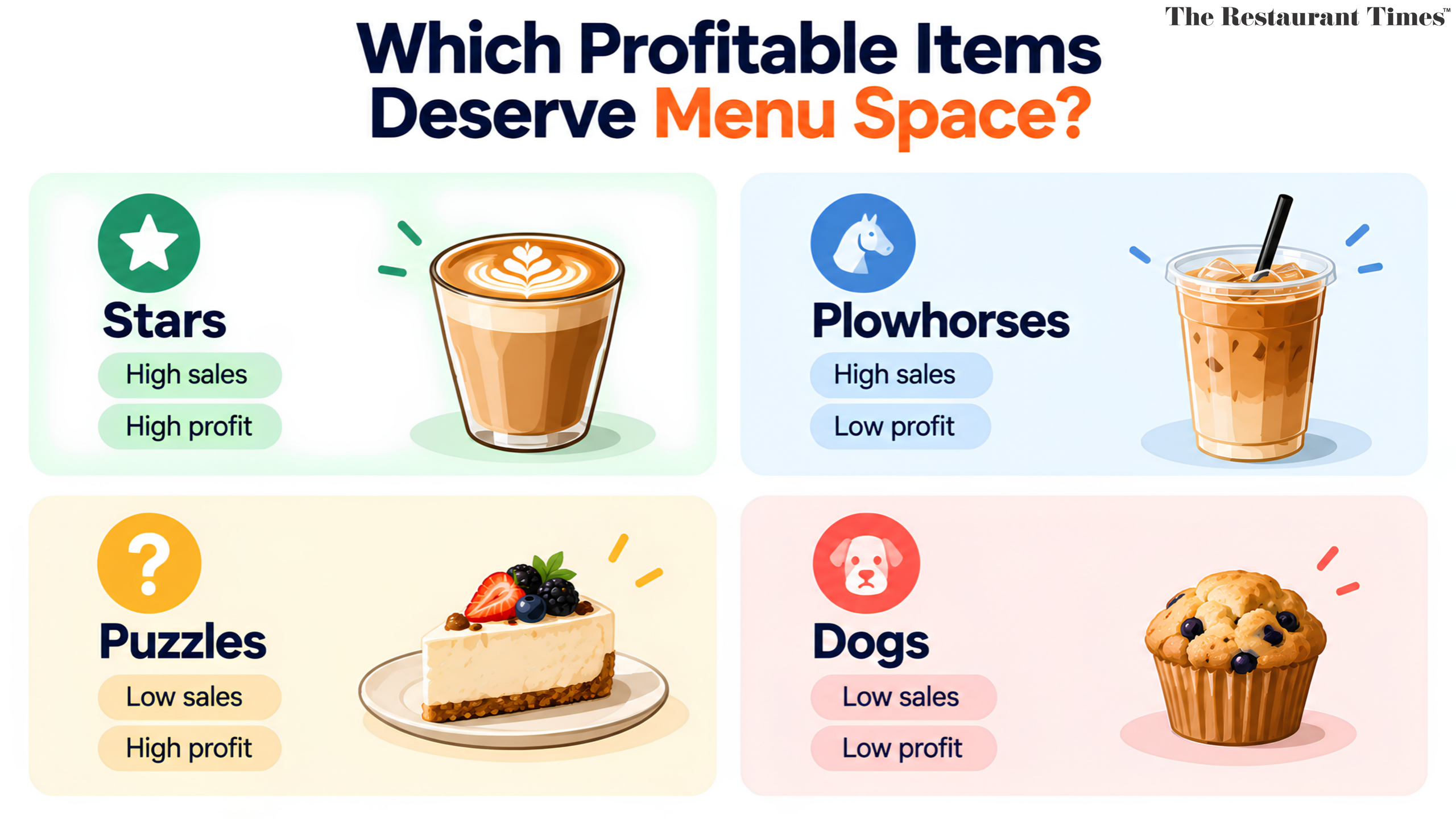
- Stars – High sales, high profit
- Plowhorses – High sales, low profit
- Puzzles – Low sales, high profit
- Dogs – Low sales, low profit
Stars are basically your most profitable menu items, and you should protect them. For plowhorses, you can trim their costs. For puzzles, make them more visible on the menu. Use bold or add them in a combo. Cut the dogs entirely.
Monitor signature drink sales weekly to assess popularity. High-margin beverages should be promoted based on sales data analysis. Watch what sells: your top sellers and crowd pleasers will usually be obvious by week three.
Menu Layout Tricks That Steer Customers to Profit
A well-structured menu balances customer preferences and profitability. Position bestselling drinks in high-visibility menu locations, then feature them with plain, appetizing descriptions that enhance appeal. Menu design should reflect brand consistency and aesthetics. Simplifying menu offerings can reduce decision fatigue for customers, and Bellwether flags overcomplicated menus as a classic margin killer. A good menu feels easy to read, so feature four tidy groups: hot, iced, signature, and seasonal.
Pricing Strategies to Protect Your Margin
Beverage pricing strategies should reflect production costs and perceived value. Start with this pricing formula: selling price equals total cost divided by one minus your target margin.
Take, for example, a drink costing $1.25 with a 70% target margin; it should be priced at around $4.17. But, but, but before finalizing the price…compare the number against the price local competitors sell that coffee at.
Also, since suppliers keep changing coffee bean prices, adjust your coffee pricing accordingly. If someone is ordering an oat milk base, they would know that oat milk is costlier than dairy milk, so charge them honestly. Smart pricing strategies also avoid blanket increases that upset regulars.
Seasonal Specials and Limited Time Offers
Seasonal specials create urgency for customers to visit. They should match local events and weather, like an iced version for a heat wave. Limited-time offers can drive sales and customer engagement, and they can boost engagement and drive repeat business. This way, limiting signature coffee drinks to seasonal menus creates urgency and allows testing of higher price points.
Run each launch like a test, and track inventory weekly. Track units sold, profit per cup, and prep time, then compare against your core beverages. Keep winners, tweak new drinks, and retire flops. Post the winners on social media, since Brikly reports bright, layered matcha drinks earn 3-4x the social engagement of coffee ones.
Keep Service Fast and Costs Tight
No matter how great a recipe is, if your service can’t match the standard, it’s a waste, because believe it or not, profitability depends on speed, so make sure, no matter what, you keep the line moving.
Write exact recipes, then train staff on portions. Regular inventory audits help prevent overstocking and spoilage. Roasting your own coffee beans can add 5–10 percentage points to beverage margins, though it would need an investment of around $25,000-$35,000 overall. Watch the wait times too, since a slow bar erases profit at any coffee shop.
Final Thoughts
The strongest menu pairs a few memorable drinks with disciplined costs, and that is the bottom line. A signature beverage menu is a powerful tool for coffee shop profitability when every item is easy to make, priced with care, and loved enough that people reorder it. Test, track, and cut what doesn’t pull its weight.
KEY TAKEAWAYS
| – Calculate beverage costs, gross margins, and prices to identify truly profitable drinks for your café. – Discover signature drink ideas, from iced teas to seasonal lattes, and use creative flavors and add-ons to enhance customer value. – Learn how to adjust pricing, manage inventory, and streamline recipes to protect margins while keeping the service line moving. – Use menu engineering and sales data to prioritize winning beverages, test new offerings, and combine add-ons with drinks customers already love. |
Frequently Asked Questions
1. What ingredients increase coffee drink margins the most?
Flavored syrups, cold foam, and cold brew concentrate increase coffee drink margins the most because they cost pennies per serving and can be batched ahead. House-made syrups also give you control over flavor, so that’s a double win.
2. How many signature drinks should a coffee shop have?
Start with two or three, enough to stand out from the chains without crowding the bar. Add a rotating seasonal slot to test new flavors once your first drinks sell steadily.
3. How do you turn popular drinks into high-margin signature items?
Take a proven seller from your coffee menu, then give it a house-made base, a distinct flavor, and a clear price premium. Use ingredients already in stock, document the recipe, and track weekly sales and profit per cup before you promote the most profitable version.