
Every home baker, sooner or later, reaches the point where it is getting too much. Orders rise beyond what a home kitchen can manage. The regular oven works for 14 hours per day on Saturdays, and oven space runs out long before the orders do. No refrigeration or cold storage exists for the custom cakes delivered on Sundays. The dining room becomes the packaging place for decorated cookies and bread. All family members devote their days to decorating their products, and regular life takes a back seat. It is not about whether or not to expand, but how to do it profitably.
Expansion of a home-based bakery to the commercial level is one of the biggest financial steps that any bakery business owner can make, and one of the most poorly informed. Home bakers scaling up often rely on their own skills and guesswork, which is where many lose money. This tutorial covers every aspect of scaling up, from costs to legal issues, and even shows you how to do it without harming your profit margin.
What You Will Learn
- The indicators that your home bakery is really ready for commercial production
- When to use commissary kitchens, shared commercial kitchens, or a dedicated commercial kitchen space
- The legalities, equipment, and production systems necessary for the process of scaling
- How to handle cash flow, pricing strategy, ingredient costs, and staffing during the process of scaling
Bakery Business Signals: When Are You Ready to Scale?
Increased activity doesn’t mean every bakery is ready to scale. Increased demand is a condition of scaling, but it is not enough. Scaling a bakery requires substantial upfront investment for commercial equipment. Before investing in a commercial kitchen, ask whether your demand is sustainable, whether your prices cover your cost of goods sold, and whether you have systematized your production process. Most bakers who skip these questions end up sacrificing quality or cash, and sometimes both.
INDUSTRY INSIGHT
| The USA bakery market is projected to expand from $101,800 million in 2025 to $129,700 million by 2031, representing a forecast CAGR of 4.1%. |
The Revenue Threshold
Bakers should make $3,000 to $5,000 or more per month from their home kitchen before considering switching to a commercial kitchen facility. Below this monthly revenue threshold, the fixed costs of a commercial space (rent, electricity, insurance, licensing) will eat away at the gains that should have come from increased volume. Accurately calculating fixed costs like rent and utilities is vital for bakery financial planning. Many home bakers fall into the common trap of scaling up before their income is sufficient to cover the overhead required for commercial food production.
Numbers are critical here, so let’s look at the real numbers. When your monthly income is $2,500, and you incur $800 monthly rent for your commissary kitchen, and insurance and supplies plus licensing costs another $400, then your overheads will increase by $1,200, which is almost half of your income, without considering the cost of ingredients, your labor, or packaging. To make sense of the math, make sure demand for your product exceeds what your home kitchen can produce before considering a commercial facility. Bakers should track sales to forecast production needs, and a monthly revenue plateauing for 3+ months suggests capacity constraints.
Production Demand vs. Home Kitchen Capacity
A clear sign that the home bakery business model is ready to scale is when you must decline or postpone orders because you don’t have enough oven space or prep space to fulfill them. Turning down orders indicates capacity issues. You should know it is time to scale up when you can’t accept custom cake orders, limit yourself to what fits in a single car at farmers’ markets, or limit decorated cookie orders because you can’t make more. Running out of storage space suggests you’re ready for a commercial kitchen, and so does a production capacity your standard oven can no longer meet.
Quality can become inconsistent at higher production volumes. Quality inconsistency at higher volumes signals a need for scaling, since a home kitchen simply cannot keep up with a growing customer base without sacrificing quality.
Commissary Kitchen vs. Shared Commercial Kitchens vs. Dedicated Commercial Space
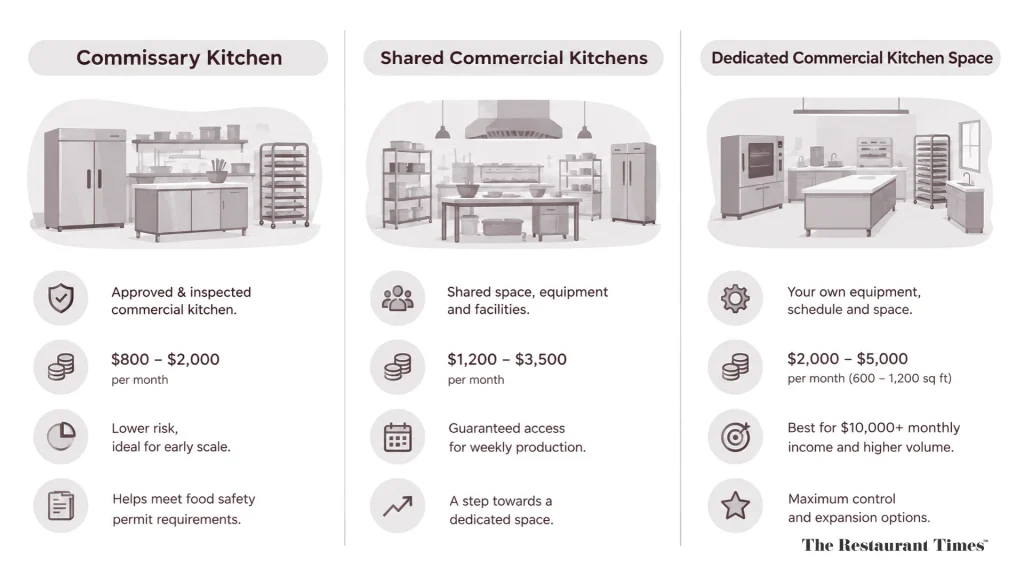
The transition from home bakery to commercial scale does not have to begin with a full commercial bakery lease. Transitioning to commercial baking may involve obtaining various food safety permits. Most home bakers who scale successfully do so in stages, starting with a commissary kitchen or shared commercial kitchen before committing to a dedicated commercial kitchen space. Using a shared commercial kitchen can reduce financial risks before committing to a dedicated space. Cloud kitchens are designed primarily for delivery-first businesses, so they rarely suit a bakery selling at farmers’ markets or to retail outlets.
Commissary Kitchen: The Lower-Risk Starting Point
A commissary kitchen is an approved, inspected commercial kitchen facility that rents space to food businesses by the hour or month. Commissary kitchens exist to support home-based food businesses that need to scale up to full-scale commercial production, which requires working in a commercially approved environment that most cottage food legislation mandates.
Commissary kitchen rentals typically range from $800 for part-time use to $2,000 for exclusive use of the facility. Shared kitchens charge $20 to $29 per hour. Commercial bakeries account for 22% of firms but generate 75% of industry revenue. For a home bakery that makes $4,000 to $6,000 in sales every month, a $600 monthly commissary rental won’t be a burden when scaling up production without signing a lease for a full commercial kitchen. Over 50% of shared kitchen users are first-timers, so you will not be alone in taking this step.
Shared Commercial Kitchens: More Access, More Cost
A shared commercial kitchen offers more committed access than a commissary; you can be assigned a dedicated period that’s exclusively yours, but you’ll still share the premises with other food service companies. The facility owns the floor space, coolers, and equipment, which are shared. Monthly fees range from $1,200 to $3,500 based on your level of access. Monthly costs for shared kitchens range from ₹8,000 to ₹20,000.
The shared commercial kitchen suits bakers who need guaranteed capacity for weekly production but haven’t yet reached a monthly income that warrants a commercial lease. It also serves as a good transitional step to see whether you need dedicated space further down the line.
Dedicated Commercial Kitchen Space: The Full Commitment
Dedicated commercial space means renting a kitchen you license as your own, with your equipment, schedule, refrigeration, and production process. It is the costliest option, but it gives you maximum control over your process, storage, and expansion options. Leasing a small commercial kitchen (600 to 1,200 square feet) will cost about $2,000 to $5,000 per month, depending on your market, square footage, and whether the space needs to be built out. Production-only leases cost $900 to $6,000 monthly. A commercial kitchen can cost ₹25,000 to ₹60,000 per month in India.
It is worth going for a dedicated commercial kitchen when your monthly income is above $10,000, you have a defined production volume that exceeds what shared kitchens can handle, and your business relationships with distributors require dedicated production space. For most home bakers looking to scale up, this is your end goal, not your starting point.
Legal Compliance When Transitioning to Commercial Scale
Legal compliance is non-negotiable when transitioning a home bakery to commercial food production. Transitioning to commercial baking may involve obtaining various food safety permits. Legal limits on production indicate that a transition to commercial kitchens is necessary. Local zoning laws often prohibit commercial food production in residential areas. Commercial bakery operations require regular health inspections and compliance with product labeling requirements. Commercial kitchens require specific surfaces and hand-washing sinks.
Food Business Licensing and Inspections
Generally, most states require a food business to obtain a license to operate as a food processor or a food establishment permit issued by the Department of Agriculture or Health. The process includes an inspection of your kitchen to ensure compliance with commercial food safety standards, as well as manager-level food safety training such as ServSafe in most states.
This licensing process takes about 4 to 12 weeks, so you should complete it before you start production. Operating without a proper license exposes you to legal and liability risks that are not worth whatever revenue you may earn. Expect to spend between $500 and $2,000 on licensing costs.
Food Safety and Quality Control Systems
The transition from home baking to commercial production requires creating the proper food safety and quality control systems that you improvised at home. This includes a documented recipe with measured quantities (larger quantities or smaller) that anyone involved in the production process can follow reliably, temperature logs for cold storage and baked items that need refrigeration, an allergen control program, and a labeling system that complies with state regulations for commercial food manufacturing. Standardized recipes help maintain quality at scale, and documented systems ensure consistent quality across all employees.
Failing to do this when producing baked goods can cause product variation that adversely affects your customers. It may also cause food safety issues, which could expose you to legal liability. Monthly oven temperature calibration prevents quality drift, and a three-stage quality check can enhance production consistency. Don’t wait until a custom cake order is rejected because you lack production records.
Commercial Kitchen Setup: Equipment Investment and Production Systems
The global bakery products market was valued at $549.3 billion in 2025 and is projected to grow from $579.0 billion in 2026 to $836.7 billion in 2033. Scaling a bakery requires substantial upfront investment for commercial equipment. Moving from a home kitchen to a commercial kitchen means leaving behind the standard oven and acquiring equipment designed for the volume and consistency your bakery business now requires.
Equipment Investment Priorities for Bakers Scaling Up
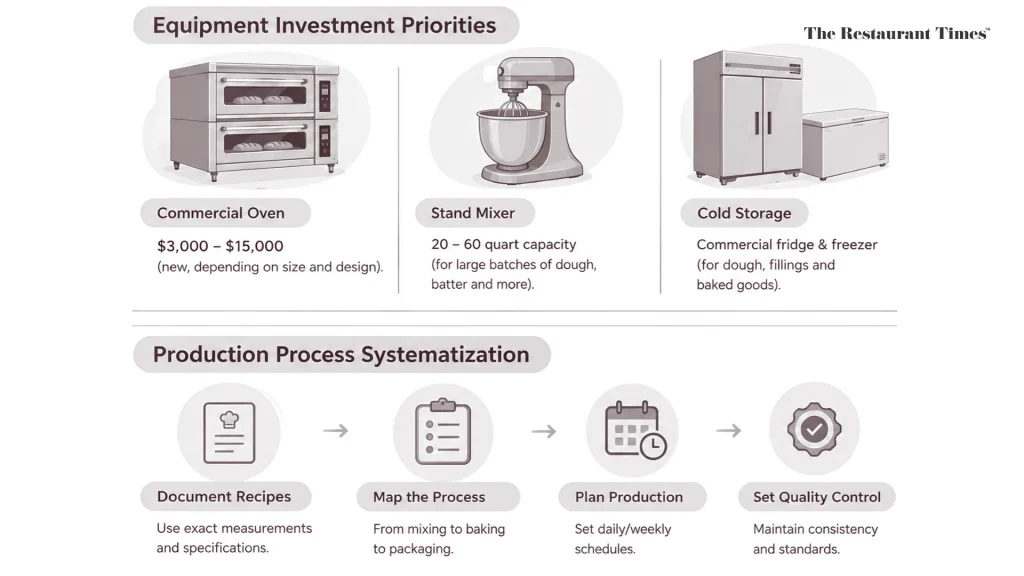
Most valuable equipment improvements for home bakers transitioning to a larger scale include: a commercial deck or convection oven (providing much larger baking volume compared to a household one), a commercial stand mixer at 20 to 60 quart capacity (needed to mix a large amount of bread dough, cake batter, and cookie dough), and cold storage (commercial refrigerator and chest freezer for bulk dough, prepared fillings, and baked goods). Smaller items such as piping bags, sheet pans, and scales add up too, so budget for them in your equipment investment.
A new commercial oven costs $3,000 to $15,000, depending on size and design. Used equipment may be 30 to 50% cheaper; however, it needs inspection before buying. Bakers who work in a commissary kitchen don’t invest in equipment at all; the kitchen provides all available equipment, which is a significant financial benefit at the early scaling stage.
Production Process Systematization
One of the most common mistakes home bakers make when expanding to commercial operations is not documenting their production process before moving to the next phase. At home, a baker knows when bread dough has fermented properly, how to organize the volume of custom cake orders for the week, and which key ingredients are expensive. At the commercial level, that knowledge becomes the baker’s property and cannot be transferred to other production workers, production days, or other production places.
Before increasing your production capacity, you need to write down all about your production process: the recipe specifications, the process that takes place from mixing the ingredients to baking the bread to packaging it up, the preparation schedule for each production day, and the quality control process. Only when you have done so will you be able to make your new hire useful.
Baked Goods Pricing: Recalculating at Commercial Scale
80% of consumers consider bakery products essential. It is important to build on customer demand. Most home bakers who move to commercial baking realize they need to recalculate their pricing because the cost structure differs between home and commercial baking. Commercial products often command a pricing multiplier of 3.5x to 4x on cost.
Your ingredient costs go up because you’re buying more at a commercial level, but your per-unit cost goes down because you’ll get wholesale pricing home bakers don’t have. You must source bulk ingredients from commercial suppliers instead of grocery stores, and bakers can increase profits by buying ingredients in bulk. However, your ingredient costs will be offset by the costs of renting the commercial kitchen, equipment costs spread over production, commercial insurance, packaging, and labor.
The pricing strategy for commercial operation must be based upon: the total ingredient cost per batch, the total time spent in the kitchen per batch (including the preparation), packaging cost per item, overhead cost allocated per unit (i.e., rent, insurance, utilities divided by production per month), and profit margin of 30 to 50 percent above the total cost. If the price calculated this way comes out significantly higher than what you are charging now, you have another indication that your home bakery price didn’t reflect the true cost, which is often the case with home bakers because they didn’t factor in the cost of their time. Wholesale margins shrink to a 30% markup versus 45% for retail, while custom cakes can deliver 60% to 70% profit margins.
Premium prices are justified if product quality supports them. Most bakers trying to compete with grocery store prices end up at a loss because they can’t operate on the same low cost base as a commercial bakery. Co-packers require minimum orders of 10,000 lbs per formula, so small bakeries should think carefully before chasing that route.
Home Bakers and Cash Flow: Managing the Financial Transition
Cash flow management determines whether a bakery business survives the scaling transition, because the period between starting to pay commercial kitchen costs and generating enough revenue to cover them is the highest-risk phase of the transition.
Building a Cash Reserve Before Scaling
The best advice from bakers who have successfully expanded from a homemade basis to commercial-level operations is to build a financial cushion before leasing commercial premises or buying commercial-grade equipment. Three to six months’ worth of cash cushion, enough to cover the total expenses of running a commercial kitchen (including rental, insurance, licensing, and ingredient costs for commercial-level operations), gives sufficient cushioning to survive the revenue ramping-up process without going into debt.
Create this financial cushion even while running your business from a home kitchen by raising prices to reach commercial-level profitability, cutting underpriced items, and saving the extra profit. This has two objectives: to accumulate the necessary cash cushion and to test the pricing level that is commercially viable.
Managing Cash Flow During Scale-Up
As soon as commercial kitchen cost generation starts, you’ll need to manage cash flow weekly, not monthly. Compare your weekly income with your weekly fixed costs and ingredient costs. Find out which weeks you do not produce enough in order to pay the overhead and understand why, whether demand is not high enough for your capacity, prices are still too low, or production itself takes too much time.
Online sales platforms and subscription options will help you manage cash flow by providing a regular weekly income stream, minimizing revenue variance in an order-driven bakery operation, and supporting revenue growth. Facebook groups, local food communities, and subscription boxes of bread or baked goods will add additional revenue streams and bring in new customers. Collaborating with local businesses can strengthen distribution and marketing, especially when you identify your target audience early. Delivery logistics and maintaining freshness are critical for bakeries supplying retailers and retail outlets.
Home Kitchen Departure: Staffing Your First Hire
A first hire becomes necessary as soon as a bakery needs more production hours than one person can provide, while also managing orders, customer communications, deliveries, and the business administration that commercial scale requires. Time spent managing compliance and staff reduces time spent baking. Finding reliable staff is essential for maintaining quality in a commercial bakery. The baking industry employs almost 800,000 skilled individuals and generates over $42 billion in direct wages.
When and How to Hire Your First Production Person
The most common mistake home bakers make is waiting too long to hire, overworking themselves unsustainably for months until they realize the business is bigger than one person. The right time to hire your first person is when you regularly work more than 50 or 60 hours a week on production and management, and the extra income from additional production capacity clearly justifies the cost of the new hire.
Your first employee in a bakery business should be a production assistant who helps with preparation, mixing, packaging, and other non-qualified production tasks that don’t require a baker’s skills and experience. It gives you the freedom to focus on more important tasks like recipe creation, quality control, customer relations, and business development. Starting with part-time work allows you to evaluate the economics of this hire before moving to a full-time salary.
Bakes and More, a local bakery with foot traffic dependency, launched a full eCommerce website with mobile optimization, multiple payment options (credit/debit, PayPal, Google Pay, Apple Pay, Buy Now Pay Later), local delivery and pickup options, AI-powered 24/7 customer service chat, and local SEO optimization. The site featured product photography, easy navigation, and content marketing via a blog. The combination of convenient ordering, multiple payment options, and always-available AI customer support removed friction from the buying process, while local SEO drove discovery from customers who previously couldn’t find the bakery online. They saw a 35% revenue increase in the first month. This is just one story; there are actually many.
Home-based food companies started scaling up much faster after 2020 because reforms to cottage food laws in many states allowed home bakers to sell a wider range of products and earn more before obtaining licensing. Local bakers who build strong customer relationships, choose the right pricing strategy, and organize production before scaling will outperform bakers who scale up first and worry about profitability afterward. One thing all successful bakery businesses have in common is that the baker saw scaling as a business transition, with production scaling coming second. Other successful bakers have followed this path.
KEY TAKEAWAYS
| – It’s time to get serious about expanding your venture, and the commissary kitchen or shared commercial kitchen is the correct place to begin because it will provide the capacity for production without the burden of a long-term lease for a commercial kitchen – Prices will have to be completely revamped based on rent, commercial insurance, increased packaging expenses, and real-time labor costs based on an hourly wage; prices that might have worked in a home kitchen environment will be too low once the venture moves to a commercial setting – Establish a cash buffer equal to three to six months of commercial kitchen expenses before renting out a commercial kitchen; this post-scaling-up revenue-generating phase is the riskiest phase of the entire process, financially speaking – Initial hiring should be based on capacity limitation and hours overload rather than waiting until you become unsustainable in your operation before doing so |
Frequently Asked Questions
1. What licenses and permits do I need to scale a home bakery to commercial?
You must have a food business license or food processing license from your state’s Department of Agriculture/Department of Health, a license for your business entity, and an inspected commercial kitchen before beginning production. If you plan to sell through grocery stores or other retail outlets, you’ll also need to meet food labeling regulations and may need USDA or state food safety certification. Research what your state requires and prepare in advance, because the licensing process usually takes 4 to 12 weeks.
2. How much does it cost to upgrade from home bakery to commercial kitchen?
This is going to depend on the route that you are taking. It will cost 300-$ 2,000 a month to use the commissary kitchen facility; this will require very little upfront money. If you have a separate commercial facility, upfront costs will range from $10,000 to $50,000, depending on rent for the first and last month, build-out costs, equipment costs, licensing, and reserve money. The third alternative falls somewhere in between: a shared commercial kitchen costs $5,000 to $15,000 upfront.
3. How do I know when my home bakery is ready to go commercial?
Signs to look for include monthly income between $3,000 and $5,000 (or higher), fewer orders because your bakery production capacity is at its peak, and production taking up all your time away from life outside the bakery. If you switch to a commercial kitchen without reaching these signs, you may find yourself spending all your profit on overhead.
4. Do I need a business plan to scale my home bakery?
Yes. A business plan will help you outline the costs, prices, production capacity, marketing, staffing, and the goals of your scaling. This plan can help if you’re seeking funding or plan to use a commercial kitchen.
5. What insurance do I need for a commercial bakery?
These can include general liability, product liability, commercial property, workers’ compensation, and equipment breakdown insurance. Insurance requirements differ by location, so check with your insurance company.